Thursday, October 2, 2008

Second HSF Fanfare

LCS-2 at the top and HSF-2 Hull A616 at the bottom of picture.

Well, everybody wanted to jump all over the news coming out of Alabama about the second HSF being revealed to the public, albeit not yet ready for seatrials. I was busy and instead just followed the news first as it came from the Mobile, Alabama Press-Register; then a bunch of blogs commenting on it; followed by the web industry news services MarineLink News, BYM Marine & Maritime News, and Marine Log; and lastly the AP and local media in Hawaii.

The first brief report came from the Press-Register Business Reporter Kaija Wilkinson in her blog on Sept. 29th: http://blog.al.com/live/2008/09/austal_launches_second_hawaii.html
I noticed people don't comment on the news blogs over in Alabama like they do in Honolulu, so I left a couple of accurate comments based on information released by the industry news services.

The second report was a complete article the next day also from Kaija Wilkinson:
http://www.al.com/business/press-register/index.ssf?/base/business/122276615047900.xml&coll=3
"Austal turns out second Hawaii Superferry"
Tuesday, September 30, 2008
By KAIJA WILKINSON

"...The yet-to-be-named vessel should be floated off the dry dock at Atlantic Marine this morning, then will head back to Austal for final work before sea trials begin later this year.

The ferry is part of a two-vessel, $190 million deal Austal landed in April 2004. While early plans tentatively called for up to five ferries, the inter-island service has been slow to start because of legal and weather complications, and Hawaii Superferry Inc. now plans to operate just two ships.

The first boat, named Alakai for "ocean path," is sailing with far less than half its capacity...

Alakai has been averaging about 300 passengers and 100 vehicles per voyage in the past several weeks...

...The first vessel...has been a target of fierce environmental opposition...

...In April, a preliminary audit found that the state bowed to pressure from Hawaii Superferry when it allowed the company to start operations without the review. The audit is ongoing...

...At 113 meters (373 feet) long, the vessel launched Monday is 6 meters (19.8 feet) longer than Alakai, thanks to a ramp Austal added to its stern, making it suitable for military use. Industry watchers have said leasing the vessel to the military is a possibility, though the company said it is sticking by its plan to operate it commercially...

...Austal is awaiting word on more military work, including a major contract to build fast ferries for the U.S. Army and Navy." [Blogger note: Incat builds the better ship.]

The most noteworthy blog on this story was from Joan Conrow on Kauai at:
http://kauaieclectic.blogspot.com/2008/09/musings-superferry-low-down.html

Of the three industry news services, Marine Log had the best pic above, and BYM had the best article, with lots of good spec data: http://www.bymnews.com/news/newsDetails.php?id=43453
"Austal launches 113 Metre advanced high speed catamaran"
Tuesday, 30 September 2008

"...With a service speed of 40 knots...

While sharing a similar specification to its sister vessel, the 113 metre high speed ferry is fitted with a 20 metre stern quarter, bi-fold ramp, for use in austere ports without shore-side loading facilities. The hydraulically operated aluminium ramp has a clear width of 4.5 metres and is designed for 42 metric ton trucks.

Powered by four MTU 20V 8000 M70 [diesel engines]...

Delivering up to 12,200 bhp (9100 kW) of continuous power...the MTU 8000 Series engines...

Austal USA has also installed...20V 8000 Series MTU diesel engines in its 127 metre Littoral Combat Ship (LCS 2) “Independence”...

Sea trials of the second Hawaii Superferry will be completed in November and December, however the contractual delivery date is not until March of 2009. See Fast Ferry images."

Regarding the "9,100 kW of continuous power" mentioned above, my comments on the Press-Register blog were:

"The ship's 4 diesel engines put out 9,100kW of energy or 9.1MW for each engine. Similar to the kind of diesel engines used in power plants. That's is enough energy to power 6,750 homes each. What a waste on unneeded and weakly demanded leisure.

BTW, speaking of weakly demanded leisure. The Austal ferry in Oman has been carrying loads of 5 people on 5 to 6 hour trips. Even the Sultan of Oman can't subsidize that indefinitely.

The waterjets were an ingenius maritime development, but with 4 or more diesel engines and with the aluminium hulls, this whole Australian business model is flawed and diametrically inconsistent with economic external event developments in the world.

It is just a matter of a little time and diminished political influence before that becomes apparent."

By the above industry news service reported specs, this second vessel is a supped-up, faster, and more militarily versatile vessel than the Alakai; "the Alakai on steroids." No doubt lessons learned with the hull of the Alakai last winter were also applied to this second vessel...although one can still remember the public comments of the first class welder Wayne Jenkins regarding his work and observations while working on the hull in the engine compartment areas of this sister ship, as he stated in his public interview. Nevertheless, this second vessel, for lack of a better name, the 'Koa,' is clearly Austal-USA's best foot forward as a construction demonstration project and prototype for their entry in the JHSV competition, subsidized with lower-interest MARAD loan guarantees and a National Defense Features DoD grant application. Whether this can compete with Incat's superior design remains to be seen.

The local media did also carry a brief AP report on the Press-Register article, and today the following basic video report was done by KGMB-9: http://kgmb9.com/main/content/view/10179/40/

My next post will be about McCain's mention of LCS in the debate with Obama,
Aloha, Brad

Report on OTF Meeting of 9/19/08 (pt.4)

Here is the Pacific Whale Foundation's summary report on Greg Kaufman's testimony before the OTF Meeting of 9/19/08: http://pacificwhale.org/news/news_detail.php?id=337

"Pacific Whale Foundation Testifies About Threats to Whales"
09/24/2008

MA'ALAEA (MAUI, HI) -- Armed with data, charts and graphs, Pacific Whale Foundation President Greg Kaufman made the case for the Hawaii Superferry to limit its speed, follow a new route that avoids whale dense areas and take other measures to protect endangered humpback whales during wintertime operations, at a meeting of the Temporary Hawaii Inter-island Ferry Oversight Task Force. The meeting took place on Friday, September 19 at Kahului Harbor's Pier 1 Passenger Terminal and was attended by more than 100 people. (Click here to download Greg's testimony.)

During his testimony, Kaufman focused on data collected by Hawaii Superferry that showed whale sightings and near-miss encounters with whales during the ferry's operation in April 2008 -- the only full month it operated during the time of year when humpback whales are present in Hawaii.

During the winter months, when humpback whales are in Hawaii to mate, give birth and care for their young, Hawaii Superferry currently has a choice of two routes during its trips between Oahu and Maui -- a "regular route" that travels north of Molokai and an "alternative route" that travels south of Molokai.

Kaufman noted that data showed that both routes were problematic in terms of the likelihood of collisions with humpback whales, with the so-called alternate route posing an especially serious risk. He urged the task force to require the Superferry to follow another route -- neither the regular or alternative route -- to avoid whale collisions. This new route would add about 13 miles to the Superferry's "regular" route and would avoid areas where whales are found in large numbers. The route proposed by Pacific Whale Foundation would avoid the whale dense area of Penguin Bank, reduce transit time in Hawaiian Islands Humpback Whale National Marine Sanctuary and minimize the amount of time the Superferry spends in waters 100 fathoms or less in depth.

According to Hawaii Superferry data from April 2008, 37 trips were made on the regular route and 11 trips followed the alternate route. Even though fewer trips followed the "alternate route," many more whale sightings and near-misses occurred along this course. In fact, 84% of the whale sightings recorded during the month of April took place while the Superferry was following the alternate route. Three of the four "near misses" that the Superferry had in April occurred while the ferry was following the alternate route.

Kaufman noted that April is a period when there are fewer whales in Hawaii than other wintertime months, because the humpback whales have begun departing for their northern feeding grounds. Even though the Superferry had limited numbers of trips during the other winter months, it is possible to extrapolate how many whale sightings and near misses would occur.

"From February 1 -29, 2008 Hawaii Superferry ran 16 ‘regular route’ trips and observed an average of 31 whales per trip. Just over six times as many whales were observed along the ‘regular route’ during February than during April," he said."Extrapolating data from the near misses on the ‘regular route’ in April to February (peak whale month) means the Superferry will have a near-miss encounter with a humpback whale during 16% of transits, or once every 6.25 trips.

"Kaufman also urged the task force to limit Hawaii Superferry to speeds of 12 knots or less in all waters of 100 fathoms or less, and while in Sanctuary designated waters, which are areas that typically have the greatest numbers of humpback whales. He pointed out that the the large mass of the Superferry, traveling at its typical speeds of 25-35 knots, will prove fatal to any whale in its path.

"Speed plays a role in collisions, but what determines the likely outcome of injury is the mass of the vessel involved in the collision," said Kaufman. "In Hawaii most, if not all, recreational craft and commercial tour boats have the fraction of the mass of a humpback whale. Whalewatch vessels are generally 10 – 50% (0.5 to 25 ton range) the mass of an adult humpback whale (which weighs 40 - 45 tons). Therefore when collisions occur between these small mass boats they are likely to injure the whale and perhaps incur some damage to themselves, but the likelihood of a fatal injury to the whale is low."

"On the other hand, the Hawaii Superferry, when lightly loaded, weighs about about 10 times the mass of a humpback, and when heavily loaded weighs about 20 times that of a humpback," he noted. "Studies have shown that when the mass of a ship is significantly greater (> 5x) than the mass of the whale, the probability of lethal strikes as a function of vessel speed is 80% at 15 knots, and 100% at 19 knots."

Kaufman also noted that Hawaii Superferry experts had testified in court that a 100-yard blind spot exists in front of the vessel. For this reason, he questioned the efficacy of the two observers the Hawaii Superferry has pledged to place on its bow to watch for whales. He recommended that the number of observers be increase to three, so that one observer could monitor a bow-mounted camera. To protect whales, Kaufman advocated that the Superferry curtail all nighttime operations with operations limited from 30 minutes prior to sunrise to 30 minutes after sunset.

Others testifying at the task force meeting voiced concern that Oahu residents were coming to Maui to harvest marine resources from an already strained ocean ecosystem. In a one month period, inspections of cars and trucks waiting to board the Superferry at Maui's Kahului Harbor resulted in the confiscation of more than 412 pounds of reef fish, 38 pounds each of deeper water fish, 'and aku, 36 pounds of 'opihi, 15 pounds of octopus and 15 pounds of edible seaweed.

Hawaii's Department of Land and Natural Resources, which has been conducting the screenings, has said that it will drop its daily presence at the Superferry terminal at the end of the year due to staffing concerns. Instead, they will screen Superferry passengers on a random basis.

"The Hawaii Superferry needs to step up and pay for independent inspectors to check every vehicle on every cruise," says Brooke Porter, Conservation Director at Pacific Whale Foundation. "If they don't, Maui's ocean environment will suffer."

For years, Pacific Whale Foundation has asked the State of Hawaii to resolve issues relating to the safety of marine wildlife in the ferry's path, and has urged the state to require an Environmental Impact Statement (EIS) before the Superferry service is allowed to begin. However, the state legislature passed a law that allowed Hawaii Superferry to operate before the EIS was completed, under certain conditions that would be established by the governor. The Temporary Hawaii Inter-island Ferry Oversight Task Force was one of those conditions.

To read Greg Kaufman's testimony, click here.

To read more Pacific Whale Foundation's Action Alert about Hawaii Superferry, click here.

Aloha, Brad

Wednesday, October 1, 2008

Report on OTF Meeting of 9/19/08 (pt.3)

The following is the most complete summary report on the OTF Meeting of 9/19/08 thusfar released to the public. Rather than organize and recreate my notes, will just refer readers to the following article reported in the local Maui Weekly paper:

http://www.mauiweekly.com/localnews/story7804.aspx
Thursday, October 02, 2008
"Superferry Resurfaces"
By Trisha Smith

"As Hawai‘i Superferry prepares for whale season, emotional public testimonies offer resolutions to conservation enforcement at final oversight task force meeting on Maui. “Maui’s resources for Maui’s people.”

The meeting of the Hawai‘i Inter-Island Large Capacity Ferry Vessel Oversight Task Force (OTF) brought many issues to light on Friday, Sept. 19, at the Kahului Harbor, Passenger Terminal.

As the Hawai‘i Superferry (HSF) celebrated its 125,000th passenger in August, many still questioned its benefits. Recent information released by the Department of Land and Natural Resources’ Division of Conservation and Resources Enforcement (DLNR/DOCARE) about the removal of natural resources proved disturbing to many Maui residents.

State conservation enforcement officers have been delegated to assist the HSF with inspections through the end of December, and provide assistance to the OTF for its final report to the State Legislature.

Several in attendance recommended conservation enforcement remain [onsite] past the cut-off date at the end of December.

“It’s important to keep DLNR there until after December,” said a West Maui lifeguard during her testimonial. “All the issues have not been addressed.”

After December, the DLNR will provide random assistance. Many suggested a $5-per-passenger surcharge be implemented to pay for the conservation enforcement services.

In a statement to the OTF, Mayor Charmaine Tavares recommended that Hawai‘i Superferry pay for DLNR officers to remain [onsite] permanently. Retired U.S. Coast Guard Admiral Richard Houck asserted that the state has the right to introduce the surcharge, not the HSF.

Nearly 100 concerned community members trickled in and out of the lengthy meeting as OTF members reported their findings and listened attentively to 26 public testimonies.

HSF’s environmental impact statement (EIS) remains unfinished with whale season right around the corner. The State Department of Transportation (DOT) is still conducting a draft for Act 2 EIS and predicts a late-October completion.

“I already feel uncomfortable that some of the issues haven’t been dealt with,” said Collette Y. Machado, trustee for the Office of Hawaiian Affairs.

Lesley Matsumoto, director of environmental consulting for Belt Collins Hawai‘i Ltd., supplied results from the rapid risk assessment (RRA), giving a preview of what the long-anticipated completed EIS the DOT hired them to do will look like.

Matsumoto went over passenger concerns, including traffic, inspection procedures and whale avoidance. According to the recent RRA, an advanced night vision and infrared-thermal imaging system with goggles will be installed on the Alakai to further assist in spotting whales.

To the audience’s gratification, Randy Awo, DLNR/DOCARE enforcement chief for Maui, questioned the firm’s survey. “Have there been any questions asked of the people of the community? When you talk about socioeconomic impacts, I find that kind of troubling. You only speak with the people who use the service, when in fact, the service has an impact on the whole community. I just don’t get it,” said Awo, shaking his head.

Awo and many others believe since resources are leaving Maui, an examination needs to “go well beyond ridership.”

At least two DOCARE officers have been [at the harbor] for each O‘ahu-bound voyage. Of the nearly 3,800 vehicles screened from Aug. 10 to Sept. 12, they confiscated over 500 pounds of various reef fish species, ‘opihi, octopus, limu loa (edible seaweed) and other natural resources, including coral called “Live Rock.”

HSF’s Houck reported ridership had declined recently, averaging 350 passengers and 100 vehicles per trip due to the new school year and continual economic decline. Houck said the removal of “resources have been small” and that he feels good about the inspection process. He also responded to why cargo violators were not being penalized. [HSF is now saying 300 p. and 100 v. per trip.]

“We can’t assess fines,” said Houck. “We can seize the material, but the state has to take action.” Houck discussed how the DLNR might implement a “Civil Resources Violations System,” where enforcement could write tickets.

Heartfelt public testimony included 20-year-old Caitlin Harrowby of Wailuku, who held up a sign stating, “Maui’s resources for Maui’s people.”

A group of high school seniors from Hana stepped up to the microphone. Some were brought to tears during testimonials on natural resources, whale season and traffic.

“Traffic’s becoming a bigger and bigger problem each day,” said Aaron Friesen, when speaking about the increase of accidents and traffic delays.

“Don’t make Maui look like another O‘ahu!” one student proclaimed.

One teary-eyed girl admitted she felt betrayed. “Keep natural resources in Maui around. Hurts me to think they won’t even exist anymore.”

Touching deposition came from an East Side man called “Uncle Kema,” as he told a compelling story of his grandmother and the “candies of the sea” — opihi. “You gotta’ ask first.”

Pacific Whale Foundation (PWF) President and Founder Greg Kaufman presented a thorough printed report. He revealed that “time is of the essence” as whale season—although predicted between January and April—in actuality, is “just weeks away.”

He called the HSF a “lethal killing machine,” but there are ways to alleviate damage.

According to the RRA, the vessel travels “at 25 knots or less when within the 100-fathom curve, whether inside or outside sanctuary waters.” Kaufman recommends 12 knots or less. Even then, he believes whales will be in danger, but at least “impact won’t be fatal and there’s a chance of recovery.”

His advised curtailing night operations, rerouting, extra cameras and employing more observers.
Maui Tomorrow Executive Director Irene Bowie received a warm response as she bulldozed through a list of costly HSF developmental and operational activities.

“It has become even more critical that Hawai‘i taxpayers be presented a public report, listing the costs which the state has incurred supporting a private, Mainland-owned corporation,” said Bowie in her informative public testimony.

According to Bowie, OTF should provide a detailed financial assessment in its final report to the legislature including—but not limited to—the $40 million to accommodate harbor changes, the yearlong operation of the task force itself and DLNR/DOCARE staffing.

One concerned man queried, “Who’s checking carry-ons?” referring to small ‘opihi. He also spoke of the need to address public safety. “What if it hits a pod? Do we have emergency help if it were to sink? Whales, yeah, but I worry about human life more than whales,” he said.

Maui’s farmers and small businesses, such as Kula’s Surfing Goat Dairy—which has increased revenue due to new O‘ahu Whole Foods—have experienced HSF benefits. HSF also claims it gives inter-island families the opportunity to travel more cost-efficiently by bringing their vehicles aboard.

Despite efforts to convince the OTF to congregate in Maui, the next meeting was set at the Honolulu Airport.

“We will take serious consideration into everything brought before us,” said Mike Fromby, DOT harbors division director and task force facilitator for OTF.

The final OTF report is anticipated to be in the hands of the legislature in January.

For more information, visit the OTF link at http://hawaii.gov/dot."

Well done, will post a few more parts to the Report on OTF Meeting of 9/19/08,
Aloha, Brad

"How much is the Superferry draining from the state’s taxpayer revenues?"

Lots of things to catch up on. Will start with Irene Bowie's recent, poignant Op-Ed, similar to her recent testimony at the most recent OTF meeting:
From: http://www.mauinews.com/page/content.detail/id/509131.html?nav=18

VIEWPOINT: "How much is the Superferry draining from the state’s taxpayer revenues?"
By IRENE BOWIE September 29, 2008

"Gov. Linda Lingle recently issued emergency orders to control and reduce state government expenditures. The state budget director is forecasting a billion-dollar shortfall in revenues through 2011 and we're told the 2009 Legislature will need to make tough decisions.

Already depleted resources for the state library system have been trimmed by another $1.2 million, and community clinics that provide basic health care services to low-income and uninsured residents are underfunded.

In this difficult financial climate priorities must be considered and it has become even more critical that Hawaii taxpayers be presented a public report listing the costs which the state has incurred supporting a private, Mainland-owned corporation, Hawaii Superferry.

A complete financial accounting is especially important because the Lingle administration's Department of Transportation violated the law by exempting the ferry operation from undergoing the required HRS 343 Environmental Review in spite of the state Supreme Court's unanimous decision that the law be upheld.

The public is well aware of the $40 million loan to accommodate the ferry at all four major harbors for barges, ramps, fences and parking areas. But consider these other items being paid for by state taxpayers:

* At least 12 Legislature-mandated, DOT-funded meetings to receive input that an environmental review would have evaluated.

* The state's purchase of land where the Kahului Railroad building is now located to accommodate Superferry's need for wharf space, and the relocation of Young Brothers' harbor operations to handle less-than-container load shipments.

* The time and money spent by the Legislature to pass bills that would override the DOT's mistaken exemption of the needed environmental review.

* A special meeting of the Environmental Council conducted by the Office of Environmental Quality Control to review the DOT exemption decision.

* The administration's actions to defeat citizen lawsuits and their ongoing appeals, including the attorney general's efforts in several lower courts and the state Supreme Court.

* A costly special legislative session called by Gov. Lingle in October to pass Act 2, giving Hawaii Superferry an exemption from environmental law.

* The expenditures resulting from Gov. Lingle's "Unified Command" utilizing various state departments, plus the National Guard, U.S. Coast Guard, and the Maui and Kauai police departments to enact an "Emergency Security Zone" in the weeks following HSF's resumption of service.

* Act 2's mandated yearlong Large-Capacity Ferry Vessel Oversight Task Force, the preparation of a rapid risk assessment and environmental impact statement, and a state auditor's investigation and report on the failures of the administration to comply with the provisions of HRS 343.

* The daily services of tugboats to hold the Alakai's barge in place at Kahului Harbor, an expense that could have been avoided if Hawaii Superferry had simply installed ramps on the ferry.

* The state Department of Agriculture inspectors at each harbor who oversee screenings by minimally trained ferry employees, as well as state Division of Conservation and Resource Enforcement officers who monitor the illegal transfer of contraband items, such as opihi, fish and limu between the islands. [Blog note-Will just add that the reef fish and limu are not limited by DLNR regs nor by the Act. 2/E.O.]

* Future costs for new ferry facilities at Kahului Harbor as projected in the 2030 Kahului Harbor Master Plan, which includes the elimination of the already-paid-for landing barge.

* And finally, projected costs for Hawaii Superferry operations at Kawaihae Harbor beginning in 2009, and additional costs if HSF resumes service to Kauai.

Maui Tomorrow has formally requested the oversight task force produce this information in its final report to the Legislature and asks the Senate Ways and Means Committee and House Finance Committee to release this document to the public and the state auditor. Taxpayers deserve to know if ongoing expenditures to underwrite Hawaii Superferry are justified or if scarce state funds could be put to better use for community services such as libraries, health clinics and schools.

In bringing this information forward legislators will be commended by community members who demand an accurate assessment of the financial impacts that result when government does not follow the law."

* Irene Bowie is executive director of the Maui Tomorrow Foundation Inc. with offices in Makawao.

Sunday, September 28, 2008

Some things that slipped by me...

Was updating the Barf-O-Meter as it will be that time soon, and in the process watched that Youtube roughride video shot from Molokai last winter. Happen to notice a couple of other Youtube videos that I had not seen. The first video shows extremely efficient 3 lane offloading and onloading of an Incat vessel by Fred Olsen in the Canary Islands. The offloading is done in 10 minutes, onloading in 5 minutes, and the vessel is in and out of the harbor in 20 minutes total. Furthermore, the loading is done on three inexpensive looking ramps in three lanes. Compare that to what we have seen here. The second video fully explains Army operations of an Incat vessel along the lines of the JHSV program. They are both good videos.


Lastly, when looking for those NOAA whale density maps of my prior post, I came across the following blog post and pictures. The guy who writes the blog and took the pictures was on the vessel when it was turned away from Nawiliwili. The pics he got are pretty interesting, and for some reason, I had not seen them:

From: http://luckywelivehawaii.blogspot.com/2007/08/my-superferry-adventure.html


One last thing for today...this one did not slip by...Ship for sale

Showed up today for sale on the net...why?...might guess...it burns diesel at 1500L/hr

http://irmarineind.com/2008/09/27/109-high-speed-passenger-ferry-for-sale/

Aloha, Brad


Friday, September 26, 2008

Back to the Report on OTF Meeting of 9/19/08 (pt.2)

OK, have some time to get back to the OTF Meeting of last Friday. I checked, and the State DOT does not have the official report on that meeting up yet on the net.

First, I'm going to break this up into multiple blog entries. It's just too much to put into one blog post.

This post will be about routes between Oahu and Maui, north and south of Molokai, taking into consideration the whale season. The real Humpback whale season begins in the next 2 to 4 weeks. The Act. 2/E.O. "whale season" begins in January when the whales are all already here. But, for now, we will focus on the routes.

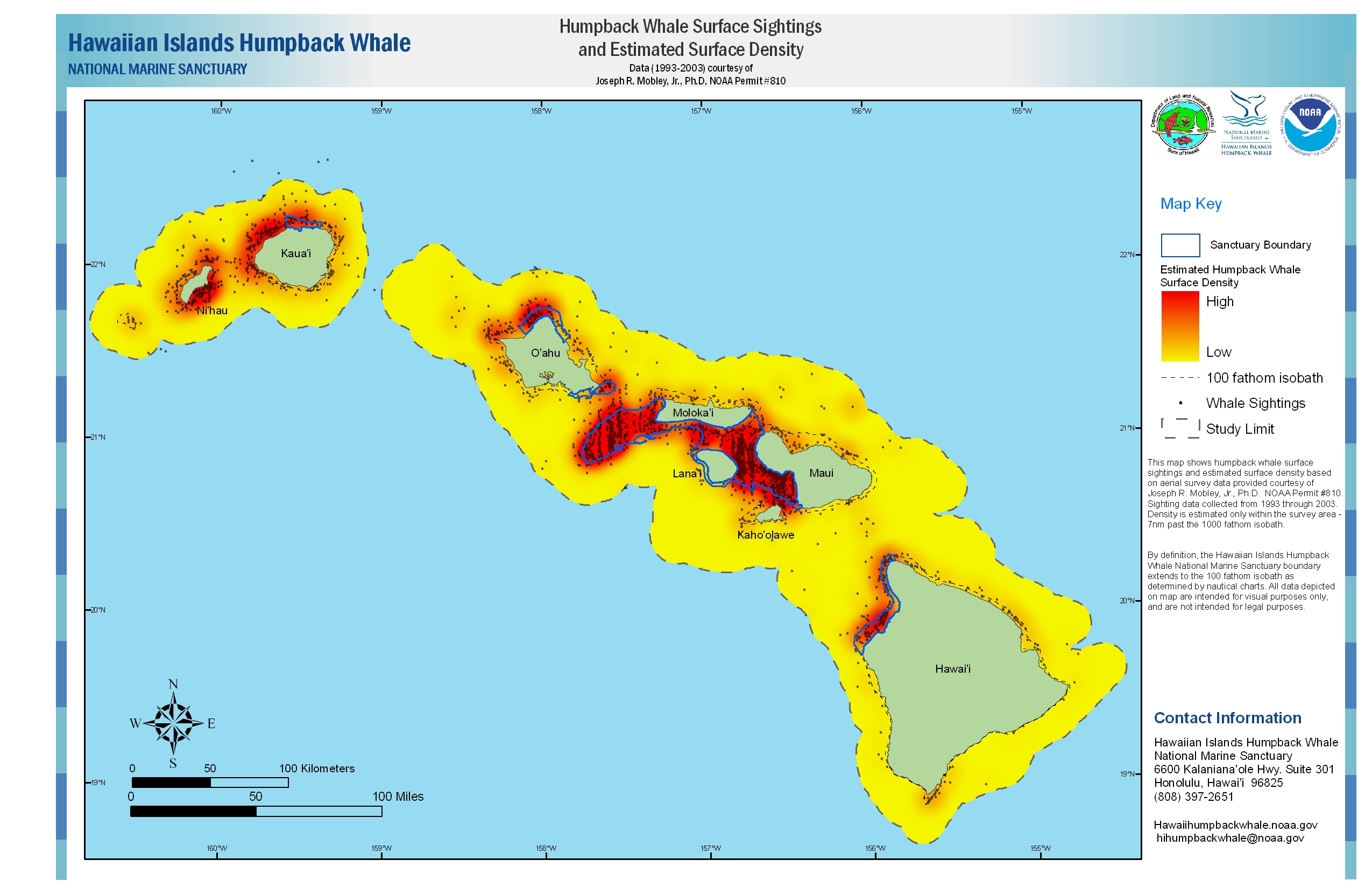
First, some pictures. The first graphic is from NOAA's website and was prepared by Dr. Mobley (advisor to Belt Collins RRA/EIS and previously DOT/HSF) and is of the Pacific Whale Sanctuary showing whale densities. Notice the large arc of whale density south of Molokai (click here to enlarge):


Next are a couple of pictures of HSF's North and South (alternate) routes. One from the Honolulu Advertiser and the other from HSF (click on source to enlarge):


Notice the routes that HSF uses above. Now, from Greg Kaufman's PWF presentation to the Ferry OTF on 9/19/08, notice the maps on pages 5-9 from that report (Slow 36 MB report) leading to the page 9 proposed alternate Southern route around the bulk of whale sitings by HSF of last April. Greg mentions the benefits of this alternate route avoiding much of the whale activity while "adding only 13 miles" (20 to 30 minutes) to HSF's transit.

Now, here is the really interesting thing found on this matter since the OTF meeting. Check out the following document: http://www.scribd.com/doc/415644/Hawaii-Superferry-Presentation. It is titled "Hawaii Superferry" dated June 19, 2006. It appears to be a DOT presentation to the community, but it also appears to have HSF developed information in it. In particular, look at page 81 of this document. It is a map prepared by Dr. Mobley either for HSF or for the state. It is titled, "We Change Routes During Whale Season To Avoid Whale-Dense Areas." Further it says, "Whale season routes go around Penguin Banks and North of Molokai." The route lines that are drawn on that map/chart on page 81 show a Southern route very similar to what Greg Kaufman/PWF more recently proposes that HSF begin using.

So, a question. This proposed Alternate Southern route that goes around Penguin Banks and the whale density in the sanctuary, that Dr. Mobley drew 2 years ago, and which Greg Kaufman rediscovered recently using HSF observation data, why hasn't HSF been required to use it all along when taking the Southern route during whale season?

More to come from the OTF Meeting,
Aloha, Brad

DLNR Seeking Input on Proposed Civil Violations

Sept. 24, 2008
http://hawaii.gov/dlnr/meetings/notices/crvs
CIVIL RESOURCE VIOLATIONS SYSTEM

Public Hearing Notice
For the Proposed Amendment of Hawaii Administrative Rules
Related to DLNR's Practice and Procedure and to the Civil Resource Violations System

Pursuant to §91-3, Hawaii Revised Statutes, the Department of Land and Natural Resources (DLNR) will hold statewide public hearings for the proposed amendment of Chapter 13-1, Hawaii Administrative Rules (HAR), Rules of Practice and Procedure. This proposed amendment would establish a Civil Resource Violations System to be managed by DLNR and amend certain rules governing the administration of DLNR and proceedings before the Board of Land and Natural Resources.

Civil Resource Violations System: The goal is to provide an administrative law proceeding to process civil resource violations in a just, speedy, and cost-effective manner, much like the traffic violation system where a small fine is enough to help change people’s behavior in the long run. It will allow violators to understand their infraction, comply with the law and avoid a tedious and costly criminal process. This system will not supersede the criminal process, but will complement it and focus on cases of less severity. Many of the cases that fall into this category have traditionally been ignored in resource enforcement. In order to set up this system, the Department has proposed to adopt a set of administrative rules and obtained the Land Board’s approval to hold public informational meetings and hearings. Information including the Board submittal and proposed rules can be found on the Department’s website (www.hawaii.gov/dlnr/).

In conjunction with the public hearings, DLNR will also hold public informational meetings to present and discuss the proposed rules and answer related questions. The public meetings and hearings are scheduled as follows:

Maui:
Thursday, October 2, 2008; Maui Waena Intermediate School, 795 Onehee Avenue, Kahului, Hawaii 96732. Informational meeting starts at 5:30 p.m., hearing at 6:30 p.m.

Kauai:
Tuesday, October 7, 2008;
Chiefess Kamakahelei Middle School, 4431 Nuhou Street, Lihue, Hawaii 96766. Informational meeting starts at 5:30 p.m., hearing at 6:30 p.m.

All interested parties are urged to attend one or more of the public hearings to present relevant information and individual opinion for DLNR to consider. Any person unable to attend or wishing to present additional comments may send written testimony by Thursday, October 30, 2008, to DLNR, Administrative Proceedings Office, 1151 Punchbowl Street, Room 130, Honolulu, Hawaii 96813, or to DLNR.CO.APO@hawaii.gov. For more information and the proposed rules, visit http://hawaii.gov/dlnr/announcements/ or contact DLNR at 587-1496.

The current rules and the proposed amendment may be downloaded for review at DLNR’s website (http://hawaii.gov/dlnr/) or be reviewed in person at the afore-mentioned office address during DLNR’s normal business hours. For additional information or a hard copy of the proposed amendment, contact DLNR at the above-mentioned addresses or telephone number.

Timeline of events:
09/24/08 - DLNR Moves Forward To Adopt Rules To Establish Civil Penalties System For Natural Resource Violations
08/31/08 - Statewide public meetings and hearings notice for October 2-30, 2008
08/13/08 - holds Hilo meeting on proposed civil penalty system for natural resource violations
07/03/08 - proposes new rules to create civil penalty system for natural resource violations
Statewide public meetings and hearings notice for July 14 - August 1, 2008
06/13/08 - Land Board Submittal: Rules Amending Title 13 Hawaii Administrative Rules
Sub-Title 1 Administration, Chapter 1 of Title 13, Rules of Practice and Procedure
05/30/08 - Rules Amending Title 13 Hawaii Administrative Rules (Draft)
Sub-Title 1 Administration, Chapter 1 of Title 13, Rules of Practice and Procedure

Wednesday, September 24, 2008

Distraction Editorials

Shoot, I'm trying to finish a report on the OTF meeting of 9/19/08, and then along comes a distracting editorial: http://www.honoluluadvertiser.com/apps/pbcs.dll/article?AID=/20080923/BREAKING06/80923100/-1/RSS01

So, I gotta take time to respond to this stuff:

From the editorial in quotes, "The state Department of Land and Natural Resources will hold statewide public meetings on new marine harvest limits. That's a move in the right direction."

Those hearings don't happen until December, see: http://hawaii.gov/dlnr/dar/announce.htm
In the meantime, the Governor could add to the enabling E.O., and recommendations on this matter should be made by the OTF Committee to the Legislature in their report.

"Most of what was confiscated by Superferry workers was obtained legally..."

Act. 2 and it's E.O. are law. On this vessel, taking opihi, coral, and rocks are prohibited by law. And taking immature opihi is always illegal and cases of that have been caught and cited in this case. Superferry workers are not allowed to issue those citations; that has to be DOCARE.

Allowed to be taken in large amounts on this vessel are limu and reef fish. Limu, though, are not allowed to be taken is some areas of Oahu, see: http://hawaii.gov/dlnr/dar/announce.htm
• New law establishes ‘Ewa limu management area •
On June 26, 2006 Gov. Lingle signed into law Act 293, which establishes an ‘Ewa limu management area, where taking of limu is prohibited.


"And forcing the Superferry to pay for state inspectors — and raise its fares — seems like overkill."

The proposed $5 surchage per passenger to pay for DOCARE/DOA on this is very reasonable.

Will go back to adding to the report next,
Aloha, Brad

Monday, September 22, 2008

Report on OTF Meeting of 9/19/08

This will be a long eyewitness report with links to full-text testimony and pictures. The OTF will eventually post a full report for this hearing up on the DOT website in a few weeks. Sometimes those reports have been abbreviated regarding the content of public testimony, as I suspect the testimony of the Hana High School students will be, so the full-text testimonies that I could get ahold of are here:

All three of these are searchable .pdf files. Thanks to Larry Geller for help with this.

Irene Bowie's Maui Tomorrow testimony with recommendations (5.4 MB):
http://disappearednews.com/docs/OTF_Testimony_9_19_08.pdf

Greg Kaufman's Pacific Whale Foundation testimony with recommendations (35.7 MB):
http://disappearednews.com/docs/OTFPWF_9_19_08.pdf

HSF responses to Belt Collins Rapid Risk Assessment recommendations (5 MB):
http://disappearednews.com/docs/RRA.pdf

I'll post this now, and add to this later.
Aloha, Brad

Recent OTF Meeting of 9/19/08

Got some blogging and pics to share from the most recent OTF meeting. Was waiting for the full-text online version of some of the presentors, including HSF's terse responses to Belt Collins' RRA, Greg Kaufman's testimony on whale avoidance and the whale season starting in 3 weeks, and Irene Bowie's testimony on total fiscal costs to the State of this project at a time when the rest of the State budget is being cut substantially. Those I have in original format, but there was actually a lot of other good testimony not detailed in the newspaper reports. I was particularly impressed with the Hana High School students' testimonies and other speakers from Hana about the documented resource depletion. I'll have my main blog post on this up soon.

For now, here is a comment I left about it on somebody else's blog today:
http://kauaieclectic.blogspot.com/2008/09/musings-breaking-silence.html

"About the OTF meeting on Sept.19th, there was actually a lot of good information from the meeting that was not reported by any of the papers. I will try to get out some of that and some pics from it in a blog post. Also look forward to the report on that OTF meeting that will eventually be put up in it's entirety on the DOT website by Mike Formby's assistant.

The overall sense I got from the meeting is that the committee members are starting to feel overwhelmed by all of the information, ideas and recommendations being presented to them by the public, DLNR/DOCARE, and DOA. As an example, two or three Maui speakers asked that of the 3 OTF committee meetings left, that one be on Kauai and one on the Big Island. During the meeting Mike Formby pointed out that the committee members need to start compiling the information and recommendations from all of the monthly meetings/reports to come up with the final report to the Legislature at the end of the year. Then at the end of the meeting, with no discussion, the next meeting of the OTF was set for Honolulu Airport. I get the sense that Kauai and the Big Island may not get a chance to see this committee in action and give testimony and that the final report may let a lot of good detail fall through the cracks."

Here are links to all of the recent newspaper articles about resource depletion and the OTF Meeting of 9/19/08:

http://starbulletin.com/2008/09/20/news/story06.html

http://www.honoluluadvertiser.com/apps/pbcs.dll/article?AID=/20080920/NEWS11/809200326/-1/RSS02

http://www.mauinews.com/page/content.detail/id/508693.html?nav=10

http://www.kauaiworld.com/articles/2008/09/20/news/news01.txt

Will add to what they have reported next,
Aloha, Brad

Tuesday, September 16, 2008

Another Good Letter and Ferry OTF Meeting Sept. 19

Another good, long letter to the editor in the Kauai paper yesterday:

http://www.kauaiworld.com/articles/2008/09/15/opinion/edit01.txt
"More Hawaii Superferry oversight needed"

"Much was made recently of Hawaii Superferry carrying its 125,000th passenger; a so-called milestone for a company where “success” is operating at half capacity.

Having recently attended a Superferry Oversight Task Force meeting, I’m struck by how little about this operation is getting out to the public.

Put in place as part of Act 2’s special legislation, the Task Force operates for one year. Its findings will be reported to the state Legislature early in 2009. As I listened to the information shared at that August meeting, it became clear just what a travesty Act 2 is.

Hawai‘i’s environmental law states that an environmental assessment must be performed prior to operation’s start. If this law had been followed, many of the problems now being brought forward could have been dealt with in advance.

One critical issue is inter-island spread of invasive species. A report prepared as part of the Superferry’s EIS process finds an unacceptable number of muddy vehicles being allowed to board. An undercarriage pressure wash system was originally suggested to mitigate this problem, but the suggestion was ignored.

Now the study finds such a system is needed, but there is no room for it in the current operations area. Had this system been required before the operation began, space would have been provided and the system would now be in place. As dirt on vehicles is a pathway for the spread of invasive species, this is of critical importance.

The report also suggested Hawaii Superferry needs to provide items as simple as a vacuum cleaner and better flashlights for their employees for more thorough inspections.

It was equally disappointing to hear Hawaii Superferry’s CEO, Admiral Thomas Fargo, state that night vision goggles, radar, and “bow-mounted cameras” that might prevent collisions with humpback whales are still not ready.

Members of the public told the Task Force in early February that the promised technology was not adequate, yet HSF continued to state through last year’s whale season that those technologies were in place and would ensure safety for humpbacks during evening transits.

Now, two months before the first whales begin arriving in Hawaiian waters, Admiral Fargo says it will take more time. This is unacceptable in regards to a federally protected and endangered species.

The only mitigation for this issue is reduced speeds, down to 10 knots (11.5 mph), when traveling after dark. An update is needed on Hawaii Superferry’s whale avoidance plan for Winter 2008-09. Will the HSF’s “whale season” be abbreviated as it was last year or run concurrent with the Hawaiian Islands Humpback Whale Sanctuary’s accepted November through May season?

DLNR’s Division of Conservation and Resources Enforcement monthly report on inspections and findings at Kahului Harbor was an eye-opening menu of natural resources being taken from Maui on a regular basis.

To have over 400 pounds of reef fish taken from Maui waters in a one-month period is astounding. Forty-nine pounds of opihi in one month; another 75 pounds the following month; over 250 pounds of limu in a month— how long will these natural resources remain for our community?

The people of Maui treasure our cultural and natural resources. Greater effort must be made to stop the plunder. DOCARE’s regular reports are the only comprehensive assessment of items leaving Maui aboard this new form of inter-island transportation.

We need continued information to make educated decisions on procedures needed, not only for Maui, but also for the Big Island as the second vessel comes online in 2009 and for Kaua‘i if HSF resumes service there. Yet these DOCARE officers will be pulled from inspections when the Task Force disbands at the end of this year.

As Gov. Lingle recently issued emergency orders to control and reduce government expenditures, now, more than ever, Hawai‘i taxpayers deserve a document released to the public, stating the costs the Department of Transportation has incurred for this one private enterprise.

What has it cost the taxpayers for Ag and DOCARE staffing? The DOT lawsuits and on-going appeals? The Oversight Task Force’s year-long operation and the preparation of an Environmental Impact Statement? The cost of barges and tugs to assist the “Alakai” at Kahului Harbor and any other costs related to the operation of this ferry system?

The next meeting of the Oversight Task Force for Hawaii Superferry will be held on Maui on Sept. 19 at the Kahului Harbor passenger terminal beginning at noon. If you are concerned about the ferry’s impact on marine mammals; our over-burdened roads, parks and beaches; and especially the plunder of our natural and cultural resources, I urge you to attend or send testimony to this meeting and let your voices be heard."

Irene Bowie,
Executive Director
Maui Tomorrow Foundation
Makawao, Hawai‘i

One Mystery Solved...in a Mobile, Alabama neighborhood

There was an interesting article a few days ago carried by Reuters about the hurricanes along the Gulf Coast and the effect on shipyards in the area. Here is a quote from that article:

http://www.reuters.com/article/newsOne/idUSN0347207520080903
Wed Sep 3, 2008
"U.S. Navy concerned about Gulf Coast post-hurricane workforce"
By Andrea Shalal-Esa
WASHINGTON (Reuters) - U.S. Navy Secretary Donald Winter said on Wednesday he was concerned about maintaining a stable workforce at Gulf Coast shipyards after the recent evacuation caused by Hurricane Gustav.
Winter said preliminary reports showed minimal, if any, damage to the yards, but he was worried about maintaining continuity in the workforce, which took a big hit after Hurricane Katrina in 2005.
"It's taken us a while to recover from Katrina in terms of the workforce, and I just worry about whether or not we're going to have another reset here," Winter told Reuters in an interview.
"It's something that we're going to have to look at very carefully," Winter said....
Winter said he worried about the impact that Katrina, Gustav and other hurricanes still expected to affect the coast would have on the "basic living environment in the Gulf area," and whether skilled workers would decide to relocate to safer, less hurricane-prone areas.
"You can do things to improve the survivability, the viability of the production facilities, but you also have to recognize that we are dependent in the long term on the ... people who make these ships, or aircraft, or whatever it is," Winter said. (Editing by Phil Berlowitz)

So, I sat on the above article for a few days, until I read the following. The following is a facinating blog entry by a neighborhood investigator from Mobile, Alabama. The writer is Nancy and she has a blog and a good flickr site. Here was her blog entry for yesterday, links to her two related flickr sets, and links to a few of her pictures after Hurricane Ike:

Sunday, September 14, 2008
"Mystery solved!"
"Does anyone remember this entry: 'Jus' Keep on Trucking'?
It took several weeks, a couple of hurricanes, some "getting 'round tuit" and finally we have discovered where the dump trucks are coming from, and where they are going!
Here again is a shot of two of the trucks going past our house.
See: http://www.flickr.com/photos/fancyhorse/sets/72157607292671167/
They go all day long, from 6:00am to 4:00pm, Monday through Saturday unless there's a storm.
I followed them, rain or shine:
I saw that they were going down the Causeway towards Mobile, but I had other things to do that day and couldn't pursue the trail until another time. On my way to Mobile a few days later, I saw that they were turning off the Causeway just east of the tunnel into town.
One Sunday after dinner, hubby and I and a friend followed the trail, and discovered their destination. Here is where they go!
http://www.flickr.com/photos/fancyhorse/2856873141/in/set-72157607292671167/
To the construction site of the Austal Shipbuilding Modular Manufacturing Facility just off the Mobile Bay Causeway, on the east shore of the Mobile River, Mobile, Alabama.
One half of the mystery solved, but we still didn't know where they were digging up all that dirt. Hubby had seen them turn onto a dirt road several miles from our house, but it was muddy that day, and he wasn't in the right vehicle for "mudding!" I was unwilling to follow them on a workday, for fear of being in the way, so we waited until another convenient Sunday afternoon, when we weren't having a hurricane or a tropical storm.
That day finally arrived today. We hopped into his old Toyota 4-Runner, and down the road we went. We turned off our road onto another paved road, then another, then onto a dirt road lined with kudzu and accompanied by lovebugs swarming all around us.
As far as we could go - a No Trespassing sign and a locked gate!
See the digger through the gate?
We went around to another road, and found another locked gate with a little bit better view:
You can actually see the top of the pit from here. I bet this is a busy place when they're digging and filling all those dump trucks! There must be hundreds of them.
Mystery solved, but I'm still no match for Jessica Fletcher or Miss Jane Marple!"

No match for Jessica Fletcher or Jane Marple? Don't sell yourself short, Nancy, this was good. Nancy has two flickr sets with pictures from this 'episode':

http://www.flickr.com/photos/fancyhorse/sets/72157607292671167/

http://www.flickr.com/photos/fancyhorse/sets/72057594134059070/?page=3

The last twenty pictures of the above second set show significant flooding in the Mobile area after the most recent Hurricane Ike. Here are the links to some of them:

http://www.flickr.com/photos/fancyhorse/2852229076/in/set-72057594134059070/

http://www.flickr.com/photos/fancyhorse/2852228880/in/set-72057594134059070/

http://www.flickr.com/photos/fancyhorse/2852228802/in/set-72057594134059070/

http://www.flickr.com/photos/fancyhorse/2852228754/in/set-72057594134059070/

http://www.flickr.com/photos/fancyhorse/2852228622/in/set-72057594134059070/

I think U.S. Navy Secretary Donald Winter has a good point.

Aloha, Brad

Just so you know...

Just so you know, I don't go looking for information on this topic anymore...it comes to me. I have some search engines set up so I don't have to look for it anymore. I comes to me automatically from around the world. Today it was Mobile. Past few days it has been the Big Island, Kauai, and Maui. A few days ago it was Oman. I just sift through the chaff to come up with the interesting tidbits on this subject. My next post is an interesting one from Mobile, Alabama.

Aloha, Brad

Sunday, September 14, 2008

Interesting Blog Post from the Big Island

This comes from a blog relatively new to me on the Big Island:

http://damontucker.wordpress.com/2008/09/13/superferry-to-get-direct-access-to-striker-brigade-w-new-27-mile-road-from-pta/
September 13, 2008
"Superferry to get Direct Access of Striker Brigade w/ New 27 Mile Road From PTA"

"I’ve made it apparent long before I had a blog, that I believe this second Superferry is being brought over here primarily for Military transport, with a belief that it will be used more so than for people.

Now it looks like the Stryker Brigade is going to have direct access to it with a 27 mile, military only, road from PTA up on Mauna Kea down to Kawaihae harbor.

Today’s Hawaii Tribune doesn’t really address the Superferry as a reason for this new 27 mile road…but why else would it be built directly to the Harbor?

'…The Army is planning more than $100 million in upgrades to PTA, including a battle complex area, a heavy-caliber live-fire training range and a new 27-mile trail from Kawaihae Harbor to the training area. But those projects are geared to use by the 5th Stryker Brigade…'"

Watch out for the DU,
Aloha, Brad

Island Breath: Superferry Rapid Risk Assessment Full Text

I like these Kauai 'hippies,' they find good stuff. See my comments at the bottom:

From: http://www.islandbreath.org/

SUBJECT: HSF PRE EIS RRA
SOURCE: JERI DIPIETRO
POSTED: 13 SEPTEMBER 2008
"Superferry Rapid Risk Assessment"
by Juan Wilson on 13 September 2008

"Jeri DiPietro has furnished us with two reports prepared by consultant Belt-Collins to the Hawaii Department of Transportation. One is titled:

'Rapid Risk Assessment of Operational Compliance and Environmental Risks of The Hawaii Superferry' click here for PDF

This document was released in August 2008 and details the study of a limited number of categories of environmental risk concerning the pre-EIS operation of the Superferry. They include:

3.1 Ocean Life and Marine Animals and Plants
3.2 Water Resources and Quality / Public Safety and Security
3.3 Vehicular Traffic
3.4 Invasive Species / Cultural and Natural Resources
3.5 Native Hawaiian Cultural Sensitivity and Awareness
3.6 Other Considerations

The report identifies no problems with catagory 3.2 dealing with water resource quality and public safety; nor does it specify any problems with catagory 3.6 "Other Considerations."

The second document is titled:

'Appendices of Rapid Risk Assessment of Operational Compliance and Environmental Risks of The Hawaii Superferry' click here for PDF

Note: The illustrations for this article are from the Appendices

We have extracted from the RRA what we thought were significant operational short-comings admitted by the Superferry Corporation that have not yet been mitigated by the time of the report.

3.1 Ocean Life and Marine Animals and Plants

"...On the nighttime legs, hand-held, monocular night vision devices were employed by the two lookouts. Although vision at twilight is impaired due to low light, night vision equipment was not typically used immediately following sunset. In addition, the hand-held and monocular aspects of the night vision device appeared to produce fatigue after just several minutes of use. Significant variation in usage of the night vision equipment by the two lookouts occurred; one used the device approximately 75 percent of the time, while the other used the device as little as 15 percent of the time. It is recommended that a binocular night vision device with a head harness be used to free up hands and avoid fatigue, and that use of the night vision equipment be standardized so that it is used consistently and continuously following sunset. It is also recommended that a study demonstrating the effectiveness of the night vision system at detecting whales be performed using scientifically accepted methods.

Bow-mounted cameras are not currently employed on the HSF vessel, as no such cameras were available during the RRA observation period. The HSF, however, has contracted Current Corporation to develop a bow-mounted infrared sensor system to aid in detecting whales. As with radar equipment, the efficacy of these sensors in detecting whales is still in the research and development phase."

3.4 Invasive Species / Cultural and Natural Resources

"...The notification provided to all passengers upon HSF ticket purchase states that all vehicles, camping, hiking, hunting, snorkeling, diving, fishing, and boating equipment (including boats and trailers) should be thoroughly washed with fresh water and be free of any debris, and that all vehicles, including “off road” or four-wheel drive vehicles, including trucks, dirt bikes, and all-terrain vehicles, will be subject to screening and inspection, including for dirt or mud. It is recommended that the notification put greater emphasis on the necessity to remove mud from vehicles, as many arriving passengers do not seem to take this requirement seriously. Additional pre-arrival vehicle cleaning procedures, including vacuuming of the interior and removal of accumulated vegetative material from under the hood, around the trunk, or inside the truck bed, should also be added to the notification.

...As dictated by E.O. 07-10 condition E.15, the HSF requires passengers to declare all plants, fruits, seeds, and any other biological medium, as indicated in the notification provided to all passengers upon ticket purchase. Verbal querying of passengers traveling without vehicles to elicit such declarations, however, was observed to be inconsistent. The HSF staff frequently omitted questions regarding non-plant materials and occasionally did not query passengers about prohibited items at all. Animals or other banned non-plant materials should be explicitly mentioned when conducting verbal screenings for prohibited items. Because of the inconsistent questioning of passengers (only 17% of passengers traveling without vehicles were verbally queried), the HSF was deemed not in compliance with E.O. 07-10 condition E.15."

3.5 Native Hawaiian Cultural Sensitivity and Awareness

"...Because the complexity and depth of the sentiment and concerns expressed cannot be easily described, let alone summarized, this RRA does not attempt to do so. Rather, only a few of the overarching concerns are presented herein. ...Current HSF operations could be viewed by some within the native Hawaiian community as lacking in understanding and integration of the host culture, language, and values. For this reason, the HSF should consider initiating dialogue with a group of respected Hawaiian leaders and collaborating with the community. The forum would demonstrate the HSF’s commitment in obtaining input from the native Hawaiian community, which could serve as a step toward repairing relations."

We [the above editors] do not feel these admissions address many of the problems that the Kauai community has expressed as concerns, nor the concerns that residents of Maui have had after a year of Superferry operations."

In quickly scanning the two RRA documents, what caught my attention was the most recent summary Coast Guard inspection report on this vessel and the following quote:

"...The Master must obtain current weather data from a recognized weather service prior to commencing any trip to ensure the following parameters are not exceeded during the voyage:

Significant Wave Height (M) Maximum Allowable Speed (kts)
0-2.8------------------------45.0
2.8-3.2----------------------37.3
3.2-3.5----------------------33.0
3.5-4.0----------------------28.0
4.0-5.0----------------------22.0
5.0-6.0----------------------19.0
6.0+ ------------------------Seek shelter at slow speed

The vessel is limited to a 6.0 meter significant wave height when carrying passengers..."

Six meters is a little more than 19 feet. It looks like the rumor that Greg heard after the mishaps last winter about a revised Coast Guard 19 feet wave operating limitation was accurate. Greg is batting a 1.000 with that kind of stuff. [The last good rumor that Greg heard was that insiders are disinclined to award one or both of the LCS/JHSV contracts based on these types of hulls.]

Also notice that there is a speed limit on this vessel below 20 knots based on wave heights, but not for whales. There is a low commercial speed limit on the Northeastern seaboard for whales, but no, not here in Hawaii. Thanks to the 'hippies' on Kauai for sharing these documents. Will look further at them.

Aloha, Brad

Saturday, September 13, 2008

Catching up...Good Kauai letters to the Editor

I've got some catching up to do here. I'll be posting some good recent letters to the editor from here on Kauai. BTW, I hear the ridership is low now on the vessel. Notice we have not heard a report on August and certainly not comparing August to July. The first letter writer below is represented in the appealed case challenging Act 2 on this matter.

http://www.kauaiworld.com/articles/2008/08/24/opinion/edit02.txt

"Tired of Superferry argument"

"I’ve been hearing with interest how some individuals have been swayed by the increased cost of fuel and the downturn in the economy toward favoring return of the Superferry. They remind me of the old movies of torture victims who finally cave in to the pain of “the rack.” The victims forget that their torturers are heartless terrorists, that they kill women and children and that giving in will condemn their culture to eons of subjugation. They simply cannot bear the pain.

We too are torture victims of a sort, taken to our limit by the political/corporate/military interests that aim to subjugate us for eons all in the name of money and power. They do not use “the rack,” they do not kill women and children, but they use insidious means to accomplish their selfish aims. However, we do not have to give in. We can see through the veil that controls us and throw off the yoke of leadership that runs our system. We can vote.

Would the Superferry help Kaua‘i? Not in the least. It will offer a more expensive, less fuel efficient, more environmentally unfriendly, slower mode of transportation and cause more traffic problems, more invasive species and more military control of the islands (not to mention more seasickness) than any other choice available. In addition, the Superferry is brought to us by a corporation that has lied to us from the beginning, a political structure that has tried deceitfully to sidestep our environmental laws and a military that has made behind the scenes agreements and has repeatedly lied about them. It is easy to understand why someone would look at the superficial arguments and favor the advent of the Superferry. After all, they are currently operating at cut rate prices and taking a loss. However, soon they will have to raise prices to meet their costs and then it will just be a military transport that also ferries wealthy visitors from island to island. Please remind me why we would want to condone this public disgrace. The developers may soon be asking us whether or not we want them to return. Please look more deeply into the issue and vote a resounding 'No thanks.'"

David Dinner
Hanalei


"‘Ferrying’ versus flying"

"The Garden Island continues to publish letters from people, such as Deborah Kaiu (“I’d come to Kaua‘i,” Letters, Aug. 22), who want to be able to come to Kaua‘i on the Superferry.

Their most often cited primary reason is their belief that the trip on the Superferry with their own car would be cheaper than flying and renting a car.

It is unfortunate that these people don’t first check prices before they write their letters. A visit to the Web sites for the Superferry, Hawaiian Airlines, and Thrifty Car Rental reveals that a round trip for two adults from O‘ahu to Maui with a standard automobile currently costs $404 for a Friday to Monday trip in mid-September. The same trip on Hawaiian Airlines with a rental car from Thrifty prices out at $370 (cheaper car rentals are available but were not priced out). I would expect that an O‘ahu/Kaua‘i flying round trip would also save at least $34 compared to the Superferry.

Some writers also mention a convenience factor. It is my belief that flying on Hawaiian Airlines with flights available almost every half hour throughout the day can be much more convenient than the Superferry that offers only one departure time in one direction and only two departure times in the other direction."

Peter Nilsen
Princeville

Along the lines of what Peter mentions above, a recent comparison that appeared in the LA Times: http://travel.latimes.com/daily-deal-blog/index.php/hawaii-superferry-de-2498/

"Hawaii Superferry: Deal or no deal?"

"The Hawaii Superferry, which shuttles between Oahu (Honolulu) and Maui (Kahului)....But is this any way for a tourist to travel?...Here’s the match-up with air service:

Time: No contest. The Oahu-Maui flight takes 35 minutes, and the ferry takes three hours.

Cost: Pretty close. For a Sept. 18 to 23 round trip, including taxes and fees, the Superferry cost $128.99 per person. The lowest airfares (also including taxes and fees), when I checked on Kayak.com, started at $146.50 on Mesa Air Group’s go! airline and $140 on Hawaiian Airlines. For Nov. 6 to 11 round trips, the ferry penciled out to $151.89, versus the lowest airfare, $141.50, for go!.

Convenience: No contest. The ferry makes one daily round trip, and sometimes two, depending on the date. Flights leave often, all day long.

Vibe: No contest. It’s way more scenic and fun to ride the waves (unless of course it’s stormy or you’re prone to seasickness) than to huddle in a coach seat.

Caveats: Superferry fares bounce up and down, depending on whether you go midweek or on the weekend and whether a hefty fuel surcharge is applied...

And then there’s the weather, which sometimes causes ferry trips to be canceled."

Aloha, Brad

Thursday, September 11, 2008

This is interesting...blogger reports on Austal ferry in Oman

http://muscatconfidential.blogspot.com/2008/09/oman-ferries-loosing-money-like-crazy.html

Wednesday, September 10, 2008
"Oman Ferries loosing money like crazy - take one of the most subsidised trips in the world today!"

"Word is the vaunted car/passenger ferries Oman purchased earlier this year - the car ferry without any jetties to load cars - are loosing money fast.

I heard that the average number of passengers on the Muscat - Kasab ferry run at the moment is 5 people. 5. Unfortunately, the ferry burns fuel like there's no tomorrow - 30,000 litres of diesel per trip. Plus the ferries were designed down in terms of weight to save money, and are therefore apparently more suitable for short, 1-2 hr type trips rather than the long 6hr+ run being used here. This means the maintainence programme is greater than anticipated, plus they are pretty high tech, so the work has to be done by expensive mechanics from Australia. So not only is the money being poured down its throat, the bills to keep it running are huge too.

Now, don't get me wrong. There's no doubt these are beautiful, world class, state of the art boats. The second ferry Hormuz just successfully broke the world speed record of its sister Shinas in July. However, as anyone who owns a boat knows, big engines and high speeds on water take 1 thing: lots and lots of hydrocarbons.

The organisational and business capability to ensure the boats are used efficiently and economically here in Oman has been a total unmitigated cock-up. Despite ordering the ferries 3 years ago, no jetties were built, nor Omani crew pre-trained. The demand for the service is obviously not great (especially as they can't put cars on them), plus there has been precious little marketing of the service either. The pricing structure is also a disaster - too expensive to come close to filling the boat or compete with going by air, but not enough to actually pay even the running costs, let alone getting capital and interest payments back. As a result, the things are just burning through the cash at a rate of knots, if you'll excuse the pun. I don't know who is responsible for the project, but he's damn lucky he's not working for me or investing my money.

I'd recommend taking a 3 day trip to Kasab as soon as possible, while you can. It'll be like having your own private multi-million dollar boat cruise. (although pack a nice lunch - food is apparently pretty spartan, and there isn't a bar either, so think about taking some magic masafi). The boats are beautiful, the trip is great, and the Ministry of National economy is paying most of your bill, so go for it!"

Austal Ferry - Hormuz
"Second Oman Ferry Betters Sister's Speed Record"

"The second of Austal’s two 65 metre vehicle-passenger ferries built for the Sultanate of Oman has become the first diesel-powered vehicle ferry to reach a speed of 56 knots. “Hormuz” recorded a maximum speed of 56 knots (103.7km/h) and a service speed of 52 knots during sea trials held near Henderson in Western Australia yesterday.

The feat makes it the fastest diesel-powered vehicle passenger ferry in the world – a title previously held by its sister vessel “Shinas”, which recorded a maximum speed of 55.9 knots last year.

The vessel is scheduled for delivery to Oman next month, where it will join “Shinas” in providing a new tourism service to Oman’s spectacular Musandam Peninsular as flagships of the Sultanate’s expanded marine transport network.

The unrivalled performance of the two 65 metre vehicle-passenger catamaran ferries showcases the world-class ability of the Austal design team, who successfully developed a new, customised, high efficiency hull design capable of delivering record-breaking performance, while Austal’s construction team managed to meet demanding weight targets." Posted by Undercover Dragon at 8:48 AM

Yeah, but were they fuel-efficient enough to be viable, esp. on more than 2 hr. routes?
Aloha, Brad

Sunday, September 7, 2008

This is Shocking...OTF Report August 20

A gentleman on Kauai named Kip has been asking me about the natural resource and invasive species issues on this subject. I put him in touch with two of the experts on this matter, both on Maui, one working for the state. I also have tried to refer Kip to the best source on what is happening on these matters revealed in the Ferry Oversight Taskforce Committee reports to the Legislature. Those reports are here. The committee will continue operating through the end of 2008. Laura Thielen also says DLNR/DOCARE will continue consistent inspections at Kahului Harbor through the end of 2008, but she mentions those state inspections will not likely continue beyond the end of 2008, without additional funding.

Looking for the links for Kip, I just finished scanning the most recent OTF Report for August, August 20 OTF REPORT FINAL.pdf . The information in that report is SHOCKING. I will publish a complete review just on that report soon. I will just say some things I noticed are the huge disparity of prohibited items reported by DOA in July alone trying to be taken onboard from Maui to Oahu (205 incidents of natural resource/aquatic life attempted violations of Act 2 EO -- opihi, crustaceans, fish, algae, rocks, and coral) compared to the much smaller number of prohibited items attempted leaving Oahu (33 incidents). Also noticeable are the items that are not prohibited by the Governor's Act 2 EO which in just two months DOCARE observed being taken in large amounts including 741 lbs. of limu and 654 lbs. of nearshore and reef fish. In addition there were 14 outright DLNR violations cited in June and July.

These numbers are shocking. Maui is being plundered, both legally and illegally. Kauai is much smaller and has a much more sensitive environment. Kauai could not take this kind of abuse. Will do a complete review of this most recent OTF Report soon.

Aloha, Brad

P.S. My attention has just been called to a poignant Op-Ed in the Maui newspaper today on these same matters, written by one of the persons that I referred Kip to over the past week. OK, it's your turn, Kip.

Wednesday, September 3, 2008

Comparing a Chapter 343 E.I.S. to an Act 2 "EIS"

I got the following question from a Kauai County Council candidate who is likely to be elected:

"Aloha, Brad
I am having a hard time distinguishing between the difference between an EIS and the Act 2 EA. If you could spell it out to me I would appreciate it."

This is a good question. I think there are a lot of people who do not know exactly the difference. From reading Act 2 and Chapter 343 and from a speech I heard Dan Hempey give based on a conversation he had with Isaac Hall, my understanding is that Act 2 does not allow for the 'no action' alternative on the project being studied, further it does not provide for the governing authority to reject and not allow the project. The 'no action' alternative is a part of a real EIS under HEPA Chapter 343 and a federal NEPA EIS.

An example of this was the development project at Laau on Molokai by the Molokai Ranch over the past year. Based on public testimony on that Chapter 343 EIS, the State Land Use Commission was set to reject that EIS, so Molokai Ranch withdrew the EIS that they had commissioned and paid for rather than have it rejected outright. The HSF Act 2 'EIS' does not have such a 'no action' or rejection possibility based upon public input.

The following is a passage written by a legal expert involved and further explains it, "Act 2 changed the very purpose of HEPA just to accommodate the Superferry Corporation. Until November 1, 2007 (the day Act 2 took effect), HEPA had been based on the fact that EA studies were “critical to humanity’s well being,…and that an environmental review process” was necessary to “alert decision makers to significant environmental effects which may result from the implementation of certain actions.” Act 2’s stated purpose is to “facilitate the establishment of interisland ferry service and, at the same time, protect Hawai‘i’s fragile environment (italics added) by clarifying that neither the preparation of an environmental assessment, nor a finding of no significant impact, nor acceptance of an environmental impact statement shall be a condition precedent to, or otherwise be required prior to … operation of a large capacity ferry vessel company.”" (Thank you to the authors for permission to quote the above paragraph.)

Here are also the full-text links to Chapter 343 and Act 2 with it's legislative history. The requirements for alternatives and for the "no action" alternative under a real NEPA/HEPA E.I.S. are here.

Aloha, Brad

P.S. A blogger/reporter on Kauai has since written another post related to this at the following.

Tuesday, September 2, 2008

Something about LCS-1 vs. LCS-2

You know, something I have been thinking about. What do LCS-1, LCS-2, and HSF and other fast ferries have in common? It is the waterjets. The waterjets are what are revolutionary.

When I watch the video of LCS-1 at full speed with the waterjets flowing and that aerodynamic steel hull cutting through the water, man that's impressive. And it is moving fast, with a solid steel hull, faster than I have seen Alakai move. So I ask myself, "Why is LCS-2 being built with a weaker aluminium hull?"

LCS-1 and LCS-2 will probably move at about the same speed, LCS-1 may burn more fuel with a heavier hull, but it will be solid, built to high quality standards, and able to handle the rigors of military service year in and year out, something that has not been shown to be the case with large aluminium hulls constructed in the U.S.

I don't know why, but for some reason someone thought it would be a 'nifty' idea to go beyond the shallow draft, diesel engines and waterjets and unnecessarily design military ships with unproven large aluminium hulls. The large aluminium hulls can be useful for commercial purposes, but are unproven and inadequate for military purposes. I will be surprised if DoD does not see the same way on this, at least for LCS, if not also JHSV. JHSV they can make a mistake on, LCS are too expensive to do wrong. The shallow draft and waterjets are the key, not the aluminium hull.

Aloha, Brad