Friday, September 26, 2008

Back to the Report on OTF Meeting of 9/19/08 (pt.2)

OK, have some time to get back to the OTF Meeting of last Friday. I checked, and the State DOT does not have the official report on that meeting up yet on the net.

First, I'm going to break this up into multiple blog entries. It's just too much to put into one blog post.

This post will be about routes between Oahu and Maui, north and south of Molokai, taking into consideration the whale season. The real Humpback whale season begins in the next 2 to 4 weeks. The Act. 2/E.O. "whale season" begins in January when the whales are all already here. But, for now, we will focus on the routes.

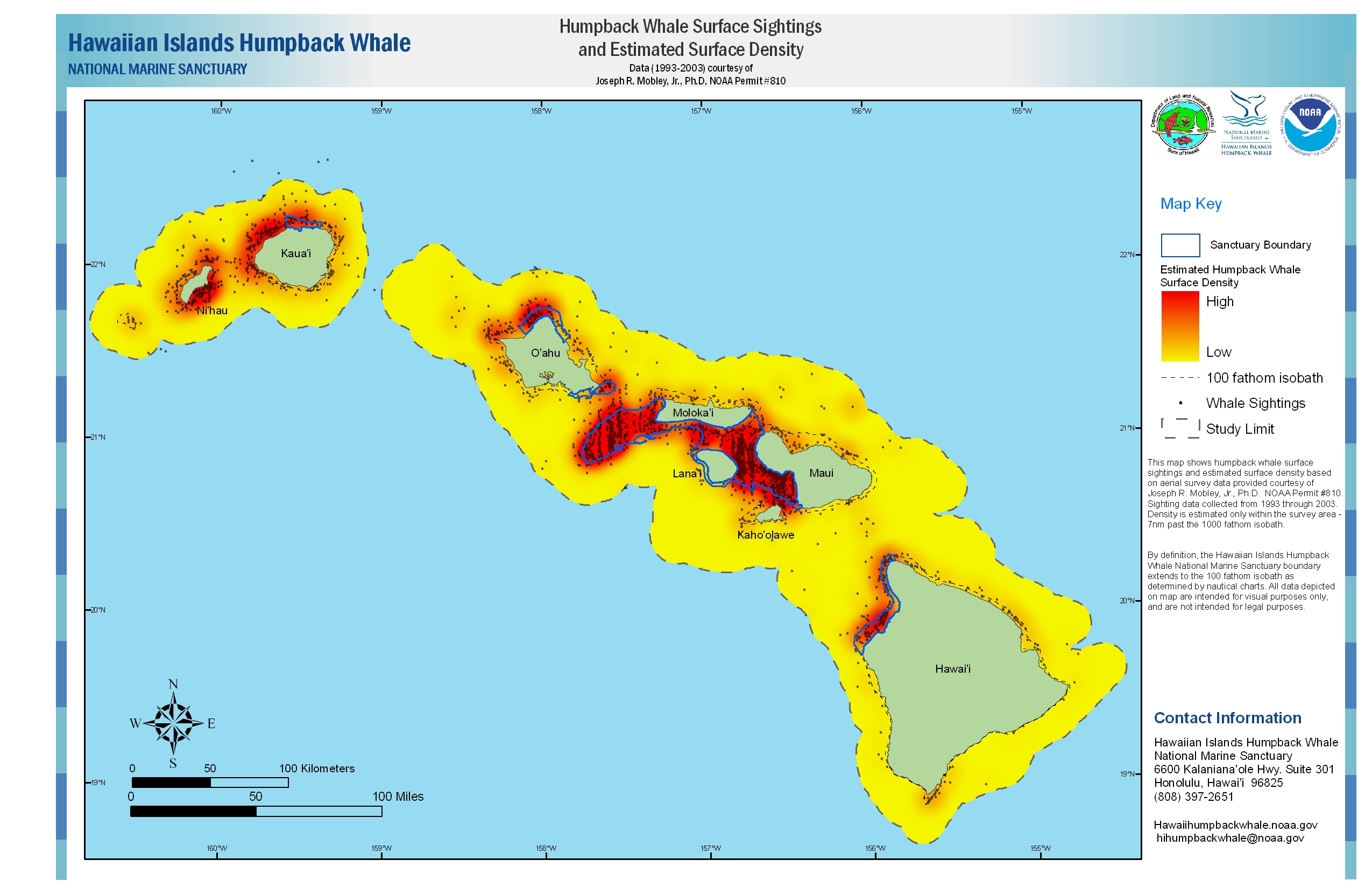
First, some pictures. The first graphic is from NOAA's website and was prepared by Dr. Mobley (advisor to Belt Collins RRA/EIS and previously DOT/HSF) and is of the Pacific Whale Sanctuary showing whale densities. Notice the large arc of whale density south of Molokai (click here to enlarge):


Next are a couple of pictures of HSF's North and South (alternate) routes. One from the Honolulu Advertiser and the other from HSF (click on source to enlarge):


Notice the routes that HSF uses above. Now, from Greg Kaufman's PWF presentation to the Ferry OTF on 9/19/08, notice the maps on pages 5-9 from that report (Slow 36 MB report) leading to the page 9 proposed alternate Southern route around the bulk of whale sitings by HSF of last April. Greg mentions the benefits of this alternate route avoiding much of the whale activity while "adding only 13 miles" (20 to 30 minutes) to HSF's transit.

Now, here is the really interesting thing found on this matter since the OTF meeting. Check out the following document: http://www.scribd.com/doc/415644/Hawaii-Superferry-Presentation. It is titled "Hawaii Superferry" dated June 19, 2006. It appears to be a DOT presentation to the community, but it also appears to have HSF developed information in it. In particular, look at page 81 of this document. It is a map prepared by Dr. Mobley either for HSF or for the state. It is titled, "We Change Routes During Whale Season To Avoid Whale-Dense Areas." Further it says, "Whale season routes go around Penguin Banks and North of Molokai." The route lines that are drawn on that map/chart on page 81 show a Southern route very similar to what Greg Kaufman/PWF more recently proposes that HSF begin using.

So, a question. This proposed Alternate Southern route that goes around Penguin Banks and the whale density in the sanctuary, that Dr. Mobley drew 2 years ago, and which Greg Kaufman rediscovered recently using HSF observation data, why hasn't HSF been required to use it all along when taking the Southern route during whale season?

More to come from the OTF Meeting,
Aloha, Brad

DLNR Seeking Input on Proposed Civil Violations

Sept. 24, 2008
http://hawaii.gov/dlnr/meetings/notices/crvs
CIVIL RESOURCE VIOLATIONS SYSTEM

Public Hearing Notice
For the Proposed Amendment of Hawaii Administrative Rules
Related to DLNR's Practice and Procedure and to the Civil Resource Violations System

Pursuant to §91-3, Hawaii Revised Statutes, the Department of Land and Natural Resources (DLNR) will hold statewide public hearings for the proposed amendment of Chapter 13-1, Hawaii Administrative Rules (HAR), Rules of Practice and Procedure. This proposed amendment would establish a Civil Resource Violations System to be managed by DLNR and amend certain rules governing the administration of DLNR and proceedings before the Board of Land and Natural Resources.

Civil Resource Violations System: The goal is to provide an administrative law proceeding to process civil resource violations in a just, speedy, and cost-effective manner, much like the traffic violation system where a small fine is enough to help change people’s behavior in the long run. It will allow violators to understand their infraction, comply with the law and avoid a tedious and costly criminal process. This system will not supersede the criminal process, but will complement it and focus on cases of less severity. Many of the cases that fall into this category have traditionally been ignored in resource enforcement. In order to set up this system, the Department has proposed to adopt a set of administrative rules and obtained the Land Board’s approval to hold public informational meetings and hearings. Information including the Board submittal and proposed rules can be found on the Department’s website (www.hawaii.gov/dlnr/).

In conjunction with the public hearings, DLNR will also hold public informational meetings to present and discuss the proposed rules and answer related questions. The public meetings and hearings are scheduled as follows:

Maui:
Thursday, October 2, 2008; Maui Waena Intermediate School, 795 Onehee Avenue, Kahului, Hawaii 96732. Informational meeting starts at 5:30 p.m., hearing at 6:30 p.m.

Kauai:
Tuesday, October 7, 2008;
Chiefess Kamakahelei Middle School, 4431 Nuhou Street, Lihue, Hawaii 96766. Informational meeting starts at 5:30 p.m., hearing at 6:30 p.m.

All interested parties are urged to attend one or more of the public hearings to present relevant information and individual opinion for DLNR to consider. Any person unable to attend or wishing to present additional comments may send written testimony by Thursday, October 30, 2008, to DLNR, Administrative Proceedings Office, 1151 Punchbowl Street, Room 130, Honolulu, Hawaii 96813, or to DLNR.CO.APO@hawaii.gov. For more information and the proposed rules, visit http://hawaii.gov/dlnr/announcements/ or contact DLNR at 587-1496.

The current rules and the proposed amendment may be downloaded for review at DLNR’s website (http://hawaii.gov/dlnr/) or be reviewed in person at the afore-mentioned office address during DLNR’s normal business hours. For additional information or a hard copy of the proposed amendment, contact DLNR at the above-mentioned addresses or telephone number.

Timeline of events:
09/24/08 - DLNR Moves Forward To Adopt Rules To Establish Civil Penalties System For Natural Resource Violations
08/31/08 - Statewide public meetings and hearings notice for October 2-30, 2008
08/13/08 - holds Hilo meeting on proposed civil penalty system for natural resource violations
07/03/08 - proposes new rules to create civil penalty system for natural resource violations
Statewide public meetings and hearings notice for July 14 - August 1, 2008
06/13/08 - Land Board Submittal: Rules Amending Title 13 Hawaii Administrative Rules
Sub-Title 1 Administration, Chapter 1 of Title 13, Rules of Practice and Procedure
05/30/08 - Rules Amending Title 13 Hawaii Administrative Rules (Draft)
Sub-Title 1 Administration, Chapter 1 of Title 13, Rules of Practice and Procedure

Wednesday, September 24, 2008

Distraction Editorials

Shoot, I'm trying to finish a report on the OTF meeting of 9/19/08, and then along comes a distracting editorial: http://www.honoluluadvertiser.com/apps/pbcs.dll/article?AID=/20080923/BREAKING06/80923100/-1/RSS01

So, I gotta take time to respond to this stuff:

From the editorial in quotes, "The state Department of Land and Natural Resources will hold statewide public meetings on new marine harvest limits. That's a move in the right direction."

Those hearings don't happen until December, see: http://hawaii.gov/dlnr/dar/announce.htm
In the meantime, the Governor could add to the enabling E.O., and recommendations on this matter should be made by the OTF Committee to the Legislature in their report.

"Most of what was confiscated by Superferry workers was obtained legally..."

Act. 2 and it's E.O. are law. On this vessel, taking opihi, coral, and rocks are prohibited by law. And taking immature opihi is always illegal and cases of that have been caught and cited in this case. Superferry workers are not allowed to issue those citations; that has to be DOCARE.

Allowed to be taken in large amounts on this vessel are limu and reef fish. Limu, though, are not allowed to be taken is some areas of Oahu, see: http://hawaii.gov/dlnr/dar/announce.htm
• New law establishes ‘Ewa limu management area •
On June 26, 2006 Gov. Lingle signed into law Act 293, which establishes an ‘Ewa limu management area, where taking of limu is prohibited.


"And forcing the Superferry to pay for state inspectors — and raise its fares — seems like overkill."

The proposed $5 surchage per passenger to pay for DOCARE/DOA on this is very reasonable.

Will go back to adding to the report next,
Aloha, Brad

Monday, September 22, 2008

Report on OTF Meeting of 9/19/08

This will be a long eyewitness report with links to full-text testimony and pictures. The OTF will eventually post a full report for this hearing up on the DOT website in a few weeks. Sometimes those reports have been abbreviated regarding the content of public testimony, as I suspect the testimony of the Hana High School students will be, so the full-text testimonies that I could get ahold of are here:

All three of these are searchable .pdf files. Thanks to Larry Geller for help with this.

Irene Bowie's Maui Tomorrow testimony with recommendations (5.4 MB):
http://disappearednews.com/docs/OTF_Testimony_9_19_08.pdf

Greg Kaufman's Pacific Whale Foundation testimony with recommendations (35.7 MB):
http://disappearednews.com/docs/OTFPWF_9_19_08.pdf

HSF responses to Belt Collins Rapid Risk Assessment recommendations (5 MB):
http://disappearednews.com/docs/RRA.pdf

I'll post this now, and add to this later.
Aloha, Brad

Recent OTF Meeting of 9/19/08

Got some blogging and pics to share from the most recent OTF meeting. Was waiting for the full-text online version of some of the presentors, including HSF's terse responses to Belt Collins' RRA, Greg Kaufman's testimony on whale avoidance and the whale season starting in 3 weeks, and Irene Bowie's testimony on total fiscal costs to the State of this project at a time when the rest of the State budget is being cut substantially. Those I have in original format, but there was actually a lot of other good testimony not detailed in the newspaper reports. I was particularly impressed with the Hana High School students' testimonies and other speakers from Hana about the documented resource depletion. I'll have my main blog post on this up soon.

For now, here is a comment I left about it on somebody else's blog today:
http://kauaieclectic.blogspot.com/2008/09/musings-breaking-silence.html

"About the OTF meeting on Sept.19th, there was actually a lot of good information from the meeting that was not reported by any of the papers. I will try to get out some of that and some pics from it in a blog post. Also look forward to the report on that OTF meeting that will eventually be put up in it's entirety on the DOT website by Mike Formby's assistant.

The overall sense I got from the meeting is that the committee members are starting to feel overwhelmed by all of the information, ideas and recommendations being presented to them by the public, DLNR/DOCARE, and DOA. As an example, two or three Maui speakers asked that of the 3 OTF committee meetings left, that one be on Kauai and one on the Big Island. During the meeting Mike Formby pointed out that the committee members need to start compiling the information and recommendations from all of the monthly meetings/reports to come up with the final report to the Legislature at the end of the year. Then at the end of the meeting, with no discussion, the next meeting of the OTF was set for Honolulu Airport. I get the sense that Kauai and the Big Island may not get a chance to see this committee in action and give testimony and that the final report may let a lot of good detail fall through the cracks."

Here are links to all of the recent newspaper articles about resource depletion and the OTF Meeting of 9/19/08:

http://starbulletin.com/2008/09/20/news/story06.html

http://www.honoluluadvertiser.com/apps/pbcs.dll/article?AID=/20080920/NEWS11/809200326/-1/RSS02

http://www.mauinews.com/page/content.detail/id/508693.html?nav=10

http://www.kauaiworld.com/articles/2008/09/20/news/news01.txt

Will add to what they have reported next,
Aloha, Brad

Tuesday, September 16, 2008

Another Good Letter and Ferry OTF Meeting Sept. 19

Another good, long letter to the editor in the Kauai paper yesterday:

http://www.kauaiworld.com/articles/2008/09/15/opinion/edit01.txt
"More Hawaii Superferry oversight needed"

"Much was made recently of Hawaii Superferry carrying its 125,000th passenger; a so-called milestone for a company where “success” is operating at half capacity.

Having recently attended a Superferry Oversight Task Force meeting, I’m struck by how little about this operation is getting out to the public.

Put in place as part of Act 2’s special legislation, the Task Force operates for one year. Its findings will be reported to the state Legislature early in 2009. As I listened to the information shared at that August meeting, it became clear just what a travesty Act 2 is.

Hawai‘i’s environmental law states that an environmental assessment must be performed prior to operation’s start. If this law had been followed, many of the problems now being brought forward could have been dealt with in advance.

One critical issue is inter-island spread of invasive species. A report prepared as part of the Superferry’s EIS process finds an unacceptable number of muddy vehicles being allowed to board. An undercarriage pressure wash system was originally suggested to mitigate this problem, but the suggestion was ignored.

Now the study finds such a system is needed, but there is no room for it in the current operations area. Had this system been required before the operation began, space would have been provided and the system would now be in place. As dirt on vehicles is a pathway for the spread of invasive species, this is of critical importance.

The report also suggested Hawaii Superferry needs to provide items as simple as a vacuum cleaner and better flashlights for their employees for more thorough inspections.

It was equally disappointing to hear Hawaii Superferry’s CEO, Admiral Thomas Fargo, state that night vision goggles, radar, and “bow-mounted cameras” that might prevent collisions with humpback whales are still not ready.

Members of the public told the Task Force in early February that the promised technology was not adequate, yet HSF continued to state through last year’s whale season that those technologies were in place and would ensure safety for humpbacks during evening transits.

Now, two months before the first whales begin arriving in Hawaiian waters, Admiral Fargo says it will take more time. This is unacceptable in regards to a federally protected and endangered species.

The only mitigation for this issue is reduced speeds, down to 10 knots (11.5 mph), when traveling after dark. An update is needed on Hawaii Superferry’s whale avoidance plan for Winter 2008-09. Will the HSF’s “whale season” be abbreviated as it was last year or run concurrent with the Hawaiian Islands Humpback Whale Sanctuary’s accepted November through May season?

DLNR’s Division of Conservation and Resources Enforcement monthly report on inspections and findings at Kahului Harbor was an eye-opening menu of natural resources being taken from Maui on a regular basis.

To have over 400 pounds of reef fish taken from Maui waters in a one-month period is astounding. Forty-nine pounds of opihi in one month; another 75 pounds the following month; over 250 pounds of limu in a month— how long will these natural resources remain for our community?

The people of Maui treasure our cultural and natural resources. Greater effort must be made to stop the plunder. DOCARE’s regular reports are the only comprehensive assessment of items leaving Maui aboard this new form of inter-island transportation.

We need continued information to make educated decisions on procedures needed, not only for Maui, but also for the Big Island as the second vessel comes online in 2009 and for Kaua‘i if HSF resumes service there. Yet these DOCARE officers will be pulled from inspections when the Task Force disbands at the end of this year.

As Gov. Lingle recently issued emergency orders to control and reduce government expenditures, now, more than ever, Hawai‘i taxpayers deserve a document released to the public, stating the costs the Department of Transportation has incurred for this one private enterprise.

What has it cost the taxpayers for Ag and DOCARE staffing? The DOT lawsuits and on-going appeals? The Oversight Task Force’s year-long operation and the preparation of an Environmental Impact Statement? The cost of barges and tugs to assist the “Alakai” at Kahului Harbor and any other costs related to the operation of this ferry system?

The next meeting of the Oversight Task Force for Hawaii Superferry will be held on Maui on Sept. 19 at the Kahului Harbor passenger terminal beginning at noon. If you are concerned about the ferry’s impact on marine mammals; our over-burdened roads, parks and beaches; and especially the plunder of our natural and cultural resources, I urge you to attend or send testimony to this meeting and let your voices be heard."

Irene Bowie,
Executive Director
Maui Tomorrow Foundation
Makawao, Hawai‘i

One Mystery Solved...in a Mobile, Alabama neighborhood

There was an interesting article a few days ago carried by Reuters about the hurricanes along the Gulf Coast and the effect on shipyards in the area. Here is a quote from that article:

http://www.reuters.com/article/newsOne/idUSN0347207520080903
Wed Sep 3, 2008
"U.S. Navy concerned about Gulf Coast post-hurricane workforce"
By Andrea Shalal-Esa
WASHINGTON (Reuters) - U.S. Navy Secretary Donald Winter said on Wednesday he was concerned about maintaining a stable workforce at Gulf Coast shipyards after the recent evacuation caused by Hurricane Gustav.
Winter said preliminary reports showed minimal, if any, damage to the yards, but he was worried about maintaining continuity in the workforce, which took a big hit after Hurricane Katrina in 2005.
"It's taken us a while to recover from Katrina in terms of the workforce, and I just worry about whether or not we're going to have another reset here," Winter told Reuters in an interview.
"It's something that we're going to have to look at very carefully," Winter said....
Winter said he worried about the impact that Katrina, Gustav and other hurricanes still expected to affect the coast would have on the "basic living environment in the Gulf area," and whether skilled workers would decide to relocate to safer, less hurricane-prone areas.
"You can do things to improve the survivability, the viability of the production facilities, but you also have to recognize that we are dependent in the long term on the ... people who make these ships, or aircraft, or whatever it is," Winter said. (Editing by Phil Berlowitz)

So, I sat on the above article for a few days, until I read the following. The following is a facinating blog entry by a neighborhood investigator from Mobile, Alabama. The writer is Nancy and she has a blog and a good flickr site. Here was her blog entry for yesterday, links to her two related flickr sets, and links to a few of her pictures after Hurricane Ike:

Sunday, September 14, 2008
"Mystery solved!"
"Does anyone remember this entry: 'Jus' Keep on Trucking'?
It took several weeks, a couple of hurricanes, some "getting 'round tuit" and finally we have discovered where the dump trucks are coming from, and where they are going!
Here again is a shot of two of the trucks going past our house.
See: http://www.flickr.com/photos/fancyhorse/sets/72157607292671167/
They go all day long, from 6:00am to 4:00pm, Monday through Saturday unless there's a storm.
I followed them, rain or shine:
I saw that they were going down the Causeway towards Mobile, but I had other things to do that day and couldn't pursue the trail until another time. On my way to Mobile a few days later, I saw that they were turning off the Causeway just east of the tunnel into town.
One Sunday after dinner, hubby and I and a friend followed the trail, and discovered their destination. Here is where they go!
http://www.flickr.com/photos/fancyhorse/2856873141/in/set-72157607292671167/
To the construction site of the Austal Shipbuilding Modular Manufacturing Facility just off the Mobile Bay Causeway, on the east shore of the Mobile River, Mobile, Alabama.
One half of the mystery solved, but we still didn't know where they were digging up all that dirt. Hubby had seen them turn onto a dirt road several miles from our house, but it was muddy that day, and he wasn't in the right vehicle for "mudding!" I was unwilling to follow them on a workday, for fear of being in the way, so we waited until another convenient Sunday afternoon, when we weren't having a hurricane or a tropical storm.
That day finally arrived today. We hopped into his old Toyota 4-Runner, and down the road we went. We turned off our road onto another paved road, then another, then onto a dirt road lined with kudzu and accompanied by lovebugs swarming all around us.
As far as we could go - a No Trespassing sign and a locked gate!
See the digger through the gate?
We went around to another road, and found another locked gate with a little bit better view:
You can actually see the top of the pit from here. I bet this is a busy place when they're digging and filling all those dump trucks! There must be hundreds of them.
Mystery solved, but I'm still no match for Jessica Fletcher or Miss Jane Marple!"

No match for Jessica Fletcher or Jane Marple? Don't sell yourself short, Nancy, this was good. Nancy has two flickr sets with pictures from this 'episode':

http://www.flickr.com/photos/fancyhorse/sets/72157607292671167/

http://www.flickr.com/photos/fancyhorse/sets/72057594134059070/?page=3

The last twenty pictures of the above second set show significant flooding in the Mobile area after the most recent Hurricane Ike. Here are the links to some of them:

http://www.flickr.com/photos/fancyhorse/2852229076/in/set-72057594134059070/

http://www.flickr.com/photos/fancyhorse/2852228880/in/set-72057594134059070/

http://www.flickr.com/photos/fancyhorse/2852228802/in/set-72057594134059070/

http://www.flickr.com/photos/fancyhorse/2852228754/in/set-72057594134059070/

http://www.flickr.com/photos/fancyhorse/2852228622/in/set-72057594134059070/

I think U.S. Navy Secretary Donald Winter has a good point.

Aloha, Brad

Just so you know...

Just so you know, I don't go looking for information on this topic anymore...it comes to me. I have some search engines set up so I don't have to look for it anymore. I comes to me automatically from around the world. Today it was Mobile. Past few days it has been the Big Island, Kauai, and Maui. A few days ago it was Oman. I just sift through the chaff to come up with the interesting tidbits on this subject. My next post is an interesting one from Mobile, Alabama.

Aloha, Brad

Sunday, September 14, 2008

Interesting Blog Post from the Big Island

This comes from a blog relatively new to me on the Big Island:

http://damontucker.wordpress.com/2008/09/13/superferry-to-get-direct-access-to-striker-brigade-w-new-27-mile-road-from-pta/
September 13, 2008
"Superferry to get Direct Access of Striker Brigade w/ New 27 Mile Road From PTA"

"I’ve made it apparent long before I had a blog, that I believe this second Superferry is being brought over here primarily for Military transport, with a belief that it will be used more so than for people.

Now it looks like the Stryker Brigade is going to have direct access to it with a 27 mile, military only, road from PTA up on Mauna Kea down to Kawaihae harbor.

Today’s Hawaii Tribune doesn’t really address the Superferry as a reason for this new 27 mile road…but why else would it be built directly to the Harbor?

'…The Army is planning more than $100 million in upgrades to PTA, including a battle complex area, a heavy-caliber live-fire training range and a new 27-mile trail from Kawaihae Harbor to the training area. But those projects are geared to use by the 5th Stryker Brigade…'"

Watch out for the DU,
Aloha, Brad

Island Breath: Superferry Rapid Risk Assessment Full Text

I like these Kauai 'hippies,' they find good stuff. See my comments at the bottom:

From: http://www.islandbreath.org/

SUBJECT: HSF PRE EIS RRA
SOURCE: JERI DIPIETRO
POSTED: 13 SEPTEMBER 2008
"Superferry Rapid Risk Assessment"
by Juan Wilson on 13 September 2008

"Jeri DiPietro has furnished us with two reports prepared by consultant Belt-Collins to the Hawaii Department of Transportation. One is titled:

'Rapid Risk Assessment of Operational Compliance and Environmental Risks of The Hawaii Superferry' click here for PDF

This document was released in August 2008 and details the study of a limited number of categories of environmental risk concerning the pre-EIS operation of the Superferry. They include:

3.1 Ocean Life and Marine Animals and Plants
3.2 Water Resources and Quality / Public Safety and Security
3.3 Vehicular Traffic
3.4 Invasive Species / Cultural and Natural Resources
3.5 Native Hawaiian Cultural Sensitivity and Awareness
3.6 Other Considerations

The report identifies no problems with catagory 3.2 dealing with water resource quality and public safety; nor does it specify any problems with catagory 3.6 "Other Considerations."

The second document is titled:

'Appendices of Rapid Risk Assessment of Operational Compliance and Environmental Risks of The Hawaii Superferry' click here for PDF

Note: The illustrations for this article are from the Appendices

We have extracted from the RRA what we thought were significant operational short-comings admitted by the Superferry Corporation that have not yet been mitigated by the time of the report.

3.1 Ocean Life and Marine Animals and Plants

"...On the nighttime legs, hand-held, monocular night vision devices were employed by the two lookouts. Although vision at twilight is impaired due to low light, night vision equipment was not typically used immediately following sunset. In addition, the hand-held and monocular aspects of the night vision device appeared to produce fatigue after just several minutes of use. Significant variation in usage of the night vision equipment by the two lookouts occurred; one used the device approximately 75 percent of the time, while the other used the device as little as 15 percent of the time. It is recommended that a binocular night vision device with a head harness be used to free up hands and avoid fatigue, and that use of the night vision equipment be standardized so that it is used consistently and continuously following sunset. It is also recommended that a study demonstrating the effectiveness of the night vision system at detecting whales be performed using scientifically accepted methods.

Bow-mounted cameras are not currently employed on the HSF vessel, as no such cameras were available during the RRA observation period. The HSF, however, has contracted Current Corporation to develop a bow-mounted infrared sensor system to aid in detecting whales. As with radar equipment, the efficacy of these sensors in detecting whales is still in the research and development phase."

3.4 Invasive Species / Cultural and Natural Resources

"...The notification provided to all passengers upon HSF ticket purchase states that all vehicles, camping, hiking, hunting, snorkeling, diving, fishing, and boating equipment (including boats and trailers) should be thoroughly washed with fresh water and be free of any debris, and that all vehicles, including “off road” or four-wheel drive vehicles, including trucks, dirt bikes, and all-terrain vehicles, will be subject to screening and inspection, including for dirt or mud. It is recommended that the notification put greater emphasis on the necessity to remove mud from vehicles, as many arriving passengers do not seem to take this requirement seriously. Additional pre-arrival vehicle cleaning procedures, including vacuuming of the interior and removal of accumulated vegetative material from under the hood, around the trunk, or inside the truck bed, should also be added to the notification.

...As dictated by E.O. 07-10 condition E.15, the HSF requires passengers to declare all plants, fruits, seeds, and any other biological medium, as indicated in the notification provided to all passengers upon ticket purchase. Verbal querying of passengers traveling without vehicles to elicit such declarations, however, was observed to be inconsistent. The HSF staff frequently omitted questions regarding non-plant materials and occasionally did not query passengers about prohibited items at all. Animals or other banned non-plant materials should be explicitly mentioned when conducting verbal screenings for prohibited items. Because of the inconsistent questioning of passengers (only 17% of passengers traveling without vehicles were verbally queried), the HSF was deemed not in compliance with E.O. 07-10 condition E.15."

3.5 Native Hawaiian Cultural Sensitivity and Awareness

"...Because the complexity and depth of the sentiment and concerns expressed cannot be easily described, let alone summarized, this RRA does not attempt to do so. Rather, only a few of the overarching concerns are presented herein. ...Current HSF operations could be viewed by some within the native Hawaiian community as lacking in understanding and integration of the host culture, language, and values. For this reason, the HSF should consider initiating dialogue with a group of respected Hawaiian leaders and collaborating with the community. The forum would demonstrate the HSF’s commitment in obtaining input from the native Hawaiian community, which could serve as a step toward repairing relations."

We [the above editors] do not feel these admissions address many of the problems that the Kauai community has expressed as concerns, nor the concerns that residents of Maui have had after a year of Superferry operations."

In quickly scanning the two RRA documents, what caught my attention was the most recent summary Coast Guard inspection report on this vessel and the following quote:

"...The Master must obtain current weather data from a recognized weather service prior to commencing any trip to ensure the following parameters are not exceeded during the voyage:

Significant Wave Height (M) Maximum Allowable Speed (kts)
0-2.8------------------------45.0
2.8-3.2----------------------37.3
3.2-3.5----------------------33.0
3.5-4.0----------------------28.0
4.0-5.0----------------------22.0
5.0-6.0----------------------19.0
6.0+ ------------------------Seek shelter at slow speed

The vessel is limited to a 6.0 meter significant wave height when carrying passengers..."

Six meters is a little more than 19 feet. It looks like the rumor that Greg heard after the mishaps last winter about a revised Coast Guard 19 feet wave operating limitation was accurate. Greg is batting a 1.000 with that kind of stuff. [The last good rumor that Greg heard was that insiders are disinclined to award one or both of the LCS/JHSV contracts based on these types of hulls.]

Also notice that there is a speed limit on this vessel below 20 knots based on wave heights, but not for whales. There is a low commercial speed limit on the Northeastern seaboard for whales, but no, not here in Hawaii. Thanks to the 'hippies' on Kauai for sharing these documents. Will look further at them.

Aloha, Brad

Saturday, September 13, 2008

Catching up...Good Kauai letters to the Editor

I've got some catching up to do here. I'll be posting some good recent letters to the editor from here on Kauai. BTW, I hear the ridership is low now on the vessel. Notice we have not heard a report on August and certainly not comparing August to July. The first letter writer below is represented in the appealed case challenging Act 2 on this matter.

http://www.kauaiworld.com/articles/2008/08/24/opinion/edit02.txt

"Tired of Superferry argument"

"I’ve been hearing with interest how some individuals have been swayed by the increased cost of fuel and the downturn in the economy toward favoring return of the Superferry. They remind me of the old movies of torture victims who finally cave in to the pain of “the rack.” The victims forget that their torturers are heartless terrorists, that they kill women and children and that giving in will condemn their culture to eons of subjugation. They simply cannot bear the pain.

We too are torture victims of a sort, taken to our limit by the political/corporate/military interests that aim to subjugate us for eons all in the name of money and power. They do not use “the rack,” they do not kill women and children, but they use insidious means to accomplish their selfish aims. However, we do not have to give in. We can see through the veil that controls us and throw off the yoke of leadership that runs our system. We can vote.

Would the Superferry help Kaua‘i? Not in the least. It will offer a more expensive, less fuel efficient, more environmentally unfriendly, slower mode of transportation and cause more traffic problems, more invasive species and more military control of the islands (not to mention more seasickness) than any other choice available. In addition, the Superferry is brought to us by a corporation that has lied to us from the beginning, a political structure that has tried deceitfully to sidestep our environmental laws and a military that has made behind the scenes agreements and has repeatedly lied about them. It is easy to understand why someone would look at the superficial arguments and favor the advent of the Superferry. After all, they are currently operating at cut rate prices and taking a loss. However, soon they will have to raise prices to meet their costs and then it will just be a military transport that also ferries wealthy visitors from island to island. Please remind me why we would want to condone this public disgrace. The developers may soon be asking us whether or not we want them to return. Please look more deeply into the issue and vote a resounding 'No thanks.'"

David Dinner
Hanalei


"‘Ferrying’ versus flying"

"The Garden Island continues to publish letters from people, such as Deborah Kaiu (“I’d come to Kaua‘i,” Letters, Aug. 22), who want to be able to come to Kaua‘i on the Superferry.

Their most often cited primary reason is their belief that the trip on the Superferry with their own car would be cheaper than flying and renting a car.

It is unfortunate that these people don’t first check prices before they write their letters. A visit to the Web sites for the Superferry, Hawaiian Airlines, and Thrifty Car Rental reveals that a round trip for two adults from O‘ahu to Maui with a standard automobile currently costs $404 for a Friday to Monday trip in mid-September. The same trip on Hawaiian Airlines with a rental car from Thrifty prices out at $370 (cheaper car rentals are available but were not priced out). I would expect that an O‘ahu/Kaua‘i flying round trip would also save at least $34 compared to the Superferry.

Some writers also mention a convenience factor. It is my belief that flying on Hawaiian Airlines with flights available almost every half hour throughout the day can be much more convenient than the Superferry that offers only one departure time in one direction and only two departure times in the other direction."

Peter Nilsen
Princeville

Along the lines of what Peter mentions above, a recent comparison that appeared in the LA Times: http://travel.latimes.com/daily-deal-blog/index.php/hawaii-superferry-de-2498/

"Hawaii Superferry: Deal or no deal?"

"The Hawaii Superferry, which shuttles between Oahu (Honolulu) and Maui (Kahului)....But is this any way for a tourist to travel?...Here’s the match-up with air service:

Time: No contest. The Oahu-Maui flight takes 35 minutes, and the ferry takes three hours.

Cost: Pretty close. For a Sept. 18 to 23 round trip, including taxes and fees, the Superferry cost $128.99 per person. The lowest airfares (also including taxes and fees), when I checked on Kayak.com, started at $146.50 on Mesa Air Group’s go! airline and $140 on Hawaiian Airlines. For Nov. 6 to 11 round trips, the ferry penciled out to $151.89, versus the lowest airfare, $141.50, for go!.

Convenience: No contest. The ferry makes one daily round trip, and sometimes two, depending on the date. Flights leave often, all day long.

Vibe: No contest. It’s way more scenic and fun to ride the waves (unless of course it’s stormy or you’re prone to seasickness) than to huddle in a coach seat.

Caveats: Superferry fares bounce up and down, depending on whether you go midweek or on the weekend and whether a hefty fuel surcharge is applied...

And then there’s the weather, which sometimes causes ferry trips to be canceled."

Aloha, Brad

Thursday, September 11, 2008

This is interesting...blogger reports on Austal ferry in Oman

http://muscatconfidential.blogspot.com/2008/09/oman-ferries-loosing-money-like-crazy.html

Wednesday, September 10, 2008
"Oman Ferries loosing money like crazy - take one of the most subsidised trips in the world today!"

"Word is the vaunted car/passenger ferries Oman purchased earlier this year - the car ferry without any jetties to load cars - are loosing money fast.

I heard that the average number of passengers on the Muscat - Kasab ferry run at the moment is 5 people. 5. Unfortunately, the ferry burns fuel like there's no tomorrow - 30,000 litres of diesel per trip. Plus the ferries were designed down in terms of weight to save money, and are therefore apparently more suitable for short, 1-2 hr type trips rather than the long 6hr+ run being used here. This means the maintainence programme is greater than anticipated, plus they are pretty high tech, so the work has to be done by expensive mechanics from Australia. So not only is the money being poured down its throat, the bills to keep it running are huge too.

Now, don't get me wrong. There's no doubt these are beautiful, world class, state of the art boats. The second ferry Hormuz just successfully broke the world speed record of its sister Shinas in July. However, as anyone who owns a boat knows, big engines and high speeds on water take 1 thing: lots and lots of hydrocarbons.

The organisational and business capability to ensure the boats are used efficiently and economically here in Oman has been a total unmitigated cock-up. Despite ordering the ferries 3 years ago, no jetties were built, nor Omani crew pre-trained. The demand for the service is obviously not great (especially as they can't put cars on them), plus there has been precious little marketing of the service either. The pricing structure is also a disaster - too expensive to come close to filling the boat or compete with going by air, but not enough to actually pay even the running costs, let alone getting capital and interest payments back. As a result, the things are just burning through the cash at a rate of knots, if you'll excuse the pun. I don't know who is responsible for the project, but he's damn lucky he's not working for me or investing my money.

I'd recommend taking a 3 day trip to Kasab as soon as possible, while you can. It'll be like having your own private multi-million dollar boat cruise. (although pack a nice lunch - food is apparently pretty spartan, and there isn't a bar either, so think about taking some magic masafi). The boats are beautiful, the trip is great, and the Ministry of National economy is paying most of your bill, so go for it!"

Austal Ferry - Hormuz
"Second Oman Ferry Betters Sister's Speed Record"

"The second of Austal’s two 65 metre vehicle-passenger ferries built for the Sultanate of Oman has become the first diesel-powered vehicle ferry to reach a speed of 56 knots. “Hormuz” recorded a maximum speed of 56 knots (103.7km/h) and a service speed of 52 knots during sea trials held near Henderson in Western Australia yesterday.

The feat makes it the fastest diesel-powered vehicle passenger ferry in the world – a title previously held by its sister vessel “Shinas”, which recorded a maximum speed of 55.9 knots last year.

The vessel is scheduled for delivery to Oman next month, where it will join “Shinas” in providing a new tourism service to Oman’s spectacular Musandam Peninsular as flagships of the Sultanate’s expanded marine transport network.

The unrivalled performance of the two 65 metre vehicle-passenger catamaran ferries showcases the world-class ability of the Austal design team, who successfully developed a new, customised, high efficiency hull design capable of delivering record-breaking performance, while Austal’s construction team managed to meet demanding weight targets." Posted by Undercover Dragon at 8:48 AM

Yeah, but were they fuel-efficient enough to be viable, esp. on more than 2 hr. routes?
Aloha, Brad

Sunday, September 7, 2008

This is Shocking...OTF Report August 20

A gentleman on Kauai named Kip has been asking me about the natural resource and invasive species issues on this subject. I put him in touch with two of the experts on this matter, both on Maui, one working for the state. I also have tried to refer Kip to the best source on what is happening on these matters revealed in the Ferry Oversight Taskforce Committee reports to the Legislature. Those reports are here. The committee will continue operating through the end of 2008. Laura Thielen also says DLNR/DOCARE will continue consistent inspections at Kahului Harbor through the end of 2008, but she mentions those state inspections will not likely continue beyond the end of 2008, without additional funding.

Looking for the links for Kip, I just finished scanning the most recent OTF Report for August, August 20 OTF REPORT FINAL.pdf . The information in that report is SHOCKING. I will publish a complete review just on that report soon. I will just say some things I noticed are the huge disparity of prohibited items reported by DOA in July alone trying to be taken onboard from Maui to Oahu (205 incidents of natural resource/aquatic life attempted violations of Act 2 EO -- opihi, crustaceans, fish, algae, rocks, and coral) compared to the much smaller number of prohibited items attempted leaving Oahu (33 incidents). Also noticeable are the items that are not prohibited by the Governor's Act 2 EO which in just two months DOCARE observed being taken in large amounts including 741 lbs. of limu and 654 lbs. of nearshore and reef fish. In addition there were 14 outright DLNR violations cited in June and July.

These numbers are shocking. Maui is being plundered, both legally and illegally. Kauai is much smaller and has a much more sensitive environment. Kauai could not take this kind of abuse. Will do a complete review of this most recent OTF Report soon.

Aloha, Brad

P.S. My attention has just been called to a poignant Op-Ed in the Maui newspaper today on these same matters, written by one of the persons that I referred Kip to over the past week. OK, it's your turn, Kip.

Wednesday, September 3, 2008

Comparing a Chapter 343 E.I.S. to an Act 2 "EIS"

I got the following question from a Kauai County Council candidate who is likely to be elected:

"Aloha, Brad
I am having a hard time distinguishing between the difference between an EIS and the Act 2 EA. If you could spell it out to me I would appreciate it."

This is a good question. I think there are a lot of people who do not know exactly the difference. From reading Act 2 and Chapter 343 and from a speech I heard Dan Hempey give based on a conversation he had with Isaac Hall, my understanding is that Act 2 does not allow for the 'no action' alternative on the project being studied, further it does not provide for the governing authority to reject and not allow the project. The 'no action' alternative is a part of a real EIS under HEPA Chapter 343 and a federal NEPA EIS.

An example of this was the development project at Laau on Molokai by the Molokai Ranch over the past year. Based on public testimony on that Chapter 343 EIS, the State Land Use Commission was set to reject that EIS, so Molokai Ranch withdrew the EIS that they had commissioned and paid for rather than have it rejected outright. The HSF Act 2 'EIS' does not have such a 'no action' or rejection possibility based upon public input.

The following is a passage written by a legal expert involved and further explains it, "Act 2 changed the very purpose of HEPA just to accommodate the Superferry Corporation. Until November 1, 2007 (the day Act 2 took effect), HEPA had been based on the fact that EA studies were “critical to humanity’s well being,…and that an environmental review process” was necessary to “alert decision makers to significant environmental effects which may result from the implementation of certain actions.” Act 2’s stated purpose is to “facilitate the establishment of interisland ferry service and, at the same time, protect Hawai‘i’s fragile environment (italics added) by clarifying that neither the preparation of an environmental assessment, nor a finding of no significant impact, nor acceptance of an environmental impact statement shall be a condition precedent to, or otherwise be required prior to … operation of a large capacity ferry vessel company.”" (Thank you to the authors for permission to quote the above paragraph.)

Here are also the full-text links to Chapter 343 and Act 2 with it's legislative history. The requirements for alternatives and for the "no action" alternative under a real NEPA/HEPA E.I.S. are here.

Aloha, Brad

P.S. A blogger/reporter on Kauai has since written another post related to this at the following.

Tuesday, September 2, 2008

Something about LCS-1 vs. LCS-2

You know, something I have been thinking about. What do LCS-1, LCS-2, and HSF and other fast ferries have in common? It is the waterjets. The waterjets are what are revolutionary.

When I watch the video of LCS-1 at full speed with the waterjets flowing and that aerodynamic steel hull cutting through the water, man that's impressive. And it is moving fast, with a solid steel hull, faster than I have seen Alakai move. So I ask myself, "Why is LCS-2 being built with a weaker aluminium hull?"

LCS-1 and LCS-2 will probably move at about the same speed, LCS-1 may burn more fuel with a heavier hull, but it will be solid, built to high quality standards, and able to handle the rigors of military service year in and year out, something that has not been shown to be the case with large aluminium hulls constructed in the U.S.

I don't know why, but for some reason someone thought it would be a 'nifty' idea to go beyond the shallow draft, diesel engines and waterjets and unnecessarily design military ships with unproven large aluminium hulls. The large aluminium hulls can be useful for commercial purposes, but are unproven and inadequate for military purposes. I will be surprised if DoD does not see the same way on this, at least for LCS, if not also JHSV. JHSV they can make a mistake on, LCS are too expensive to do wrong. The shallow draft and waterjets are the key, not the aluminium hull.

Aloha, Brad

Sunday, August 31, 2008

NeoCon's "New American Century" isn't even working

Check these out. We spend the better part of a trillion dollars on the effort and look where the contract goes. That's what happens when you go in pushing people around disrespectfully.

http://www.nytimes.com/2008/08/29/world/middleeast/29iraq.html?ref=world
"Iraq Signs Oil Deal With China Worth Up to $3 Billion"
By ERICA GOODE and RIYADH MOHAMMED
Published: August 28, 2008

BAGHDAD — In the first major oil deal Iraq has made with a foreign country since 2003, the Iraqi government and the China National Petroleum Corporation have signed a contract in Beijing that could be worth up to $3 billion, Iraqi officials said Thursday...Rest of article here.

http://www.latimes.com/news/nationworld/iraq/complete/la-fiw-chinairaq29-2008aug29,0,1138339.story
"China, Iraq to revive oil field development deal;
The project was canceled after the 2003 U.S.-led invasion"
By Elaine Kurtenbach, The Associated Press August 29, 2008

SHANGHAI -- China and Iraq have signed a $3-billion deal revising an earlier agreement for China's biggest oil company to help develop the Ahdab oil field, an official at Iraq's Oil Ministry said Thursday...Rest of article here.


Aloha, Brad

Saturday, August 30, 2008

Excellent Critique by a West Point Graduate of the NeoCons

This is an excellent evaluation forwarded to me by Kauai resident, David Ward. It is an outstanding critique of the big picture that this little issue here on this blog falls within. Among other things, this critique clearly explains the intellectual bankruptcy of the NeoCons:

http://www.pbs.org/moyers/journal/08152008/transcript1.html
"The Limits of Power: The End of American Exceptionalism"

"BILL MOYERS: Welcome to the JOURNAL.

America's in a pickle. Our friends, the Russians, with whom we were about to conduct joint military exercises, decided instead to attack some of our other friends, the Georgians, who not only aspire to democracy but control access to lots of oil and pipelines in which American energy companies have huge investments. But when President Bush demands Russia go home and leave Georgia alone, his pal Vladimir Putin - the modern Russian czar - gets that sardonic smile on his face.

He knows that American troops are spread so thin in Iraq and Afghanistan that Uncle Sam more resembles Gulliver, tied down by too many commitments, too much hubris, and too many mistakes, than he does to Superman. It's a pickle and a predicament, and it's serious.

The limits of American power have never been more vividly on display. That's the subject of my conversation this week with Andrew J. Bacevich. Here is a public thinker who has been able to find an audience across the political spectrum, from THE NATION or THE AMERICAN CONSERVATIVE magazines, lecturing to college classes or testifying before Congress.

Bacevich speaks truth to power, no matter who's in power, which may be why those of both the left and right listen to him.

Perhaps it's also because when he challenges American myths and illusions, he does so from a patriotism forged in the fire of experience as a soldier in Vietnam.

After 23 years in the Army, the West Point graduate retired as a colonel and has been teaching international relations and history at Boston University. Bacevich has published several acclaimed books, including this one, THE NEW AMERICAN MILITARISM. His latest, published this week, is THE LIMITS OF POWER: THE END OF AMERICAN EXCEPTIONALISM.

He's with me now. Welcome to the JOURNAL.

ANDREW BACEVICH: Thank you very much for having me.

BILL MOYERS: It's been a long time since I've read a book in which I highlighted practically every third sentence. So, it took me a while to read, what is in fact, a rather short book. You began with a quote from the Bible, the Book of Second Kings, chapter 20, verse one. 'Set thine house in order.' How come that admonition?

ANDREW BACEVICH: Well, I've been troubled by the course of U.S. foreign policy for a long, long time. And I wrote the book in order to sort out my own thinking about where our basic problems lay. And I really reached the conclusion that our biggest problems are within.

I think there's a tendency on the part of policy makers and probably a tendency on the part of many Americans to think that the problems we face are problems that are out there somewhere, beyond our borders. And that if we can fix those problems, then we'll be able to continue the American way of life as it has long existed. I think it's fundamentally wrong. Our major problems are at home.

BILL MOYERS: So, this is a version of 'Physician, heal thyself?'

ANDREW BACEVICH: Well, yes, 'Physician, heal thyself,' and you begin healing yourself by looking at yourself in the mirror and seeing yourself as you really are.

BILL MOYERS: Here is one of those neon sentences. Quote, 'The pursuit of freedom, as defined in an age of consumerism, has induced a condition of dependence on imported goods, on imported oil, and on credit. The chief desire of the American people,' you write, 'is that nothing should disrupt their access to these goods, that oil, and that credit. The chief aim of the U.S. government is to satisfy that desire, which it does in part of through the distribution of largesse here at home, and in part through the pursuit of imperial ambitions abroad.' In other words, you're saying that our foreign policy is the result of a dependence on consumer goods and credit.

ANDREW BACEVICH: Our foreign policy is not something simply concocted by people in Washington D.C. and imposed on us. Our foreign policy is something that is concocted in Washington D.C., but it reflects the perceptions of our political elite about what we want, we the people want. And what we want, by and large - I mean, one could point to many individual exceptions - but, what we want, by and large is, we want this continuing flow of very cheap consumer goods.

We want to be able to pump gas into our cars regardless of how big they may happen to be, in order to be able to drive wherever we want to be able to drive. And we want to be able to do these things without having to think about whether or not the book's balanced at the end of the month, or the end of the fiscal year. And therefore, we want this unending line of credit.

BILL MOYERS: You intrigued me when you wrote that 'The fundamental problem facing the country will remain stubbornly in place no matter who is elected in November.' What's the fundamental problem you say is not going away no matter whether it's McCain or Obama?

ANDREW BACEVICH: What neither of these candidates will be able to, I think, accomplish is to persuade us to look ourselves in the mirror, to see the direction in which we are headed. And from my point of view, it's a direction towards ever greater debt and dependency.

BILL MOYERS: And you write that 'What will not go away, is a yawning disparity between what Americans expect, and what they're willing or able to pay.' Explore that a little bit.

ANDREW BACEVICH: Well, I think one of the ways we avoid confronting our refusal to balance the books is to rely increasingly on the projection of American military power around the world to try to maintain this dysfunctional system, or set of arrangements that have evolved over the last 30 or 40 years.

But, it's not the American people who are deploying around the world. It is a very specific subset of our people, this professional army. We like to call it an all-volunteer force-

BILL MOYERS: Right.

ANDREW BACEVICH: -but the truth is, it's a professional army, and when we think about where we send that army, it's really an imperial army. I mean, if as Americans, we could simply step back a little bit, and contemplate the significance of the fact that Americans today are fighting in Iraq and Afghanistan, and ask ourselves, how did it come to be that organizing places like Iraq and Afghanistan should have come to seem to be critical to the well-being of the United States of America.

There was a time, seventy, eighty, a hundred years ago, that we Americans sat here in the western hemisphere, and puzzled over why British imperialists went to places like Iraq and Afghanistan. We viewed that sort of imperial adventurism with disdain. But, it's really become part of what we do. Unless a President could ask fundamental questions about our posture in the world, it becomes impossible then, for any American President to engage the American people in some sort of a conversation about how and whether or not to change the way we live.

BILL MOYERS: How is Iraq a clear manifestation, as you say, of this, 'yawning disparity between what Americans expect, and what they're willing to pay?'

ANDREW BACEVICH: Let's think about World War Two. A war that President Roosevelt told us was essential to U.S. national security, and was. And President Roosevelt said at the time, because this is an important enterprise, you, the American people, will be called upon to make sacrifices. And indeed, the people of the United States went off to fight that war in large numbers. It was a national effort. None of that's been true with regard to Iraq. I mean, one of the most striking things about the way the Bush Administration has managed the Global War on Terror, which President Bush has compared to World War Two.

BILL MOYERS: Right.

ANDREW BACEVICH: One of the most striking things about it is that there was no effort made to mobilize the country, there was actually no effort even made to expand the size of the armed forces, as a matter of fact. The President said just two weeks or so after 9/11, 'Go to Disney World. Go shopping.' Well, there's something out of whack here, if indeed the Global War on Terror, and Iraq as a subset of the Global War on Terror is said to be so critically important, on the one hand. And on the other hand, when the country basically goes about its business, as if, really, there were no War on Terror, and no war in Iraq ongoing at all.

BILL MOYERS: 'So it is,' you write, 'seven years into its confrontation with radical Islam, the United States finds itself with too much war for too few warriors and with no prospect of producing the additional soldiers needed to close the gap.' When I hear all this talk about increasing the troops in Afghanistan from two to three battalions, maybe even more, I keep asking myself, where are we going to get those troops?

ANDREW BACEVICH: Well, and of course the answer is, they have to come from Iraq. I mean, as we speak, the security conditions in Iraq have improved a little bit, and in a sense, it's just in time, because what the Pentagon wants to do is to draw down its presence in Iraq to some degree, not in order to give those troops a breather, but in order to redeploy them after a period of retraining to Afghanistan, because Afghanistan is going so poorly. So, we're having a very difficult time managing two wars which, in the 20th century context, they're actually relatively small.

BILL MOYERS: You say, 'U.S. troops in battle dress and body armor, whom Americans profess to admire and support, pay the price for the nation's refusal to confront our domestic dysfunction.' What are we not confronting?

ANDREW BACEVICH: The most obvious, the blindingly obviously question, is energy. It's oil. I think historians a hundred years from now will puzzle over how it could be that the United States of America, the most powerful nation in the world, as far back as the early 1970s, came to recognize that dependence on foreign oil was a problem, posed a threat, comprised our freedom of action.

How every President from Richard Nixon down to the present one, President Bush, declared, 'We're gonna fix this problem.' None of them did. And the reason we are in Iraq today is because the Persian Gulf is at the center of the world's oil reserves. I don't mean that we invaded Iraq on behalf of big oil, but the Persian Gulf region would have zero strategic significance, were it not for the fact that that's where the oil is.

Back in 1980, I think, President Carter, in many respects when he declared the Carter Doctrine, and said that henceforth, the Persian Gulf had enormous strategic significance to the United States and the United States is not going to permit any other country to control that region of the world.

And that set in motion a set of actions that has produced the militarization of U.S. policy, ever deeper U.S. military involvement in the region, and in essence, has postponed that day of reckoning when we need to understand the imperative of having an energy policy, and trying to restore some semblance of energy independence.

BILL MOYERS: And this is connected, as you say in the book, in your first chapters, of what you call 'the crisis of profligacy.'

ANDREW BACEVICH: Well, we don't live within our means. I mean, the nation doesn't, and increasingly, individual Americans don't. Our saving - the individual savings rate in this country is below zero. The personal debt, national debt, however you want to measure it, as individuals and as a government, and as a nation we assume an endless line of credit.

As individuals, the line of credit is not endless, that's one of the reasons why we're having this current problem with the housing crisis, and so on. And my view would be that the nation's assumption, that its line of credit is endless, is also going to be shown to be false. And when that day occurs it's going to be a black day, indeed.

BILL MOYERS: You call us an 'empire of consumption.'

ANDREW BACEVICH: I didn't create that phrase. It's a phrase drawn from a book by a wonderful historian at Harvard University, Charles Maier, and the point he makes in his very important book is that, if we think of the United States at the apex of American power, which I would say would be the immediate post World War Two period, through the Eisenhower years, into the Kennedy years. We made what the world wanted. They wanted our cars. We exported our television sets, our refrigerators - we were the world's manufacturing base. He called it an 'empire of production.'

BILL MOYERS: Right.

ANDREW BACEVICH: Sometime around the 1960s there was a tipping point, when the 'empire of production' began to become the 'empire of consumption.' When the cars started to be produced elsewhere, and the television sets, and the socks, and everything else. And what we ended up with was the American people becoming consumers rather than producers.

BILL MOYERS: And you say this has produced a condition of profound dependency, to the extent, and I'm quoting you, 'Americans are no longer masters of their own fate.'

ANDREW BACEVICH: Well, they're not. I mean, the current debt to the Chinese government grows day by day. Why? Well, because of the negative trade balance. Our negative trade balance with the world is something in the order of $800 billion per year. That's $800 billion of stuff that we buy, so that we can consume, that is $800 billion greater than the amount of stuff that we sell to them. That's a big number. I mean, it's a big number even relative to the size of our economy.

BILL MOYERS: And you use this metaphor that is intriguing. American policy makers, quote, 'have been engaged in a de facto Ponzi scheme, intended to extend indefinitely, the American line of credit.' What's going on that resembles a Ponzi scheme?

ANDREW BACEVICH: This continuing tendency to borrow and to assume that the bills are never going to come due. I testified before a House committee six weeks ago now, on the future of U.S grand strategy. I was struck by the questions coming from members that showed an awareness, a sensitivity, and a deep concern, about some of the issues that I tried to raise in the book.

'How are we gonna pay the bills? How are we gonna pay for the commitment of entitlements that is going to increase year by year for the next couple of decades, especially as baby boomers retire?' Nobody has answers to those questions. So, I was pleased that these members of Congress understood the problem. I was absolutely taken aback when they said, 'Professor, what can we do about this?' And their candid admission that they didn't have any answers, that they were perplexed, that this problem of learning to live within our means seemed to have no politically plausible solution.

BILL MOYERS: You say in here that the tipping point between wanting more than we were willing to pay for began in the Johnson Administration. 'We can fix the tipping point with precision,' you write. 'It occurred between 1965, when President Lyndon Baines Johnson ordered U.S. combat troops to South Vietnam, and 1973, when President Richard Nixon finally ended direct U.S. involvement in that war.' Why do you see that period so crucial?

ANDREW BACEVICH: When President Johnson became President, our trade balance was in the black. By the time we get to the Nixon era, it's in the red. And it stays in the red down to the present. Matter of fact, the trade imbalance becomes essentially larger year by year.
So, I think that it is the '60s, generally, the Vietnam period, slightly more specifically, was the moment when we began to lose control of our economic fate. And most disturbingly, we're still really in denial. We still haven't recognized that.

BILL MOYERS: Now you go on to say that there was another fateful period between July 1979 and March of 1983. You describe it, in fact, as a pivot of contemporary American history. That includes Jimmy Carter and Ronald Reagan, right?

ANDREW BACEVICH: Well, I would be one of the first to confess that - I think that we have misunderstood and underestimated President Carter. He was the one President of our time who recognized, I think, the challenges awaiting us if we refused to get our house in order.

BILL MOYERS: You're the only author I have read, since I read Jimmy Carter, who gives so much time to the President's speech on July 15th, 1979. Why does that speech speak to you so strongly?

ANDREW BACEVICH: Well, this is the so-called Malaise Speech, even though he never used the word 'malaise' in the text to the address. It's a very powerful speech, I think, because President Carter says in that speech, oil, our dependence on oil, poses a looming threat to the country. If we act now, we may be able to fix this problem. If we don't act now, we're headed down a path in which not only will we become increasingly dependent upon foreign oil, but we will have opted for a false model of freedom. A freedom of materialism, a freedom of self-indulgence, a freedom of collective recklessness. And what the President was saying at the time was, we need to think about what we mean by freedom. We need to choose a definition of freedom which is anchored in truth, and the way to manifest that choice, is by addressing our energy problem.

He had a profound understanding of the dilemma facing the country in the post Vietnam period. And of course, he was completely hooted, derided, disregarded.

BILL MOYERS: And he lost the election. You in fact say-

ANDREW BACEVICH: Exactly.

BILL MOYERS: -this speech killed any chance he had of winning reelection. Why? Because the American people didn't want to settle for less?

ANDREW BACEVICH: They absolutely did not. And indeed, the election of 1980 was the great expression of that, because in 1980, we have a candidate, perhaps the most skillful politician of our time, Ronald Reagan, who says that, 'Doom-sayers, gloom-sayers, don't listen to them. The country's best days are ahead of us.'

BILL MOYERS: Morning in America.

ANDREW BACEVICH: It's Morning in America. And you don't have to sacrifice, you can have more, all we need to do is get government out of the way, and drill more holes for oil, because the President led us to believe the supply of oil was infinite.

BILL MOYERS: You describe Ronald Reagan as the 'modern prophet of profligacy. The politician who gave moral sanction to the empire of consumption.'

ANDREW BACEVICH: Well, to understand the truth about President Reagan, is to understand why so much of what we imagined to be our politics is misleading and false. He was the guy who came in and said we need to shrink the size of government. Government didn't shrink during the Reagan era, it grew.

He came in and he said we need to reduce the level of federal spending. He didn't reduce it, it went through the roof, and the budget deficits for his time were the greatest they had been since World War Two.

BILL MOYERS: And do you remember that it was his successor, his Vice President, the first President Bush who said in 1992, the American way of life is not negotiable.

ANDREW BACEVICH: And all presidents, again, this is not a Republican thing, or a Democratic thing, all presidents, all administrations are committed to that proposition. Now, I would say, that probably, 90 percent of the American people today would concur. The American way of life is not up for negotiation.

What I would invite them to consider is that, if you want to preserve that which you value most in the American way of life, and of course you need to ask yourself, what is it you value most. That if you want to preserve that which you value most in the American way of life, then we need to change the American way of life. We need to modify that which may be peripheral, in order to preserve that which is at the center of what we value.

BILL MOYERS: What do you value most?

ANDREW BACEVICH: Well, I think the clearest statement of what I value is found in the preamble to the Constitution. There is nothing in the preamble to the Constitution which defines the purpose of the United States of America as remaking the world in our image, which I view as a fool's errand. There is nothing in the preamble of the Constitution that ever imagined that we would embark upon an effort, as President Bush has defined it, to transform the Greater Middle East. This region of the world that incorporates something in order of 1.4 billion people.

I believe that the framers of the Constitution were primarily concerned with focusing on the way we live here, the way we order our affairs. To try to ensure that as individuals, we can have an opportunity to pursue our, perhaps, differing definitions of freedom, but also so that, as a community, we could live together in some kind of harmony. And that future generations would also be able to share in those same opportunities.

The big problem, it seems to me, with the current crisis in American foreign policy, is that unless we do change our ways, the likelihood that our children, our grandchildren, the next generation is going to enjoy the opportunities that we've had, is very slight, because we're squandering our power. We are squandering our wealth. In many respects, to the extent that we persist in our imperial delusions, we're also going to squander our freedom because imperial policies, which end up enhancing the authority of the imperial president, also end up providing imperial presidents with an opportunity to compromise freedom even here at home. And we've seen that since 9/11.

BILL MOYERS: The disturbing thing that you say again and again in here, is that every President since Reagan has relied on military power to conceal or manage these problems that stem from the nation's habits of profligacy, right?

ANDREW BACEVICH: That's exactly right. And again, this is, I think, this is another issue where one needs to be unsparing in fixing responsibility as much on liberal Democratic presidents as conservative Republican ones. I think that the Bush Administration's response to 9/11 in constructing this paradigm of a global war on terror, in promulgating the so called, Bush Doctrine of Preventive War, in plunging into Iraq - utterly unnecessary war - will go down in our history as a record of recklessness that will be probably unmatched by any other administration.

But, doesn't really mean that Bill Clinton before him, or George Herbert Walker Bush before him, or Ronald Reagan before him, were all that much better. Because they all have seen military power as our strong suit. They all have worked under the assumption that through the projection of power, or the threat to employ power, that we can fix the world. Fix the world in order to sustain this dysfunctional way of life that we have back here.

BILL MOYERS: So, this brings us to what you call the political crisis of America. And you say, 'The actual system of government conceived by the framers no longer pertains.' What pertains?

ANDREW BACEVICH: I am expressing in the book, in a sense, what many of us sense, even if many of us don't really want to confront the implications. The Congress, especially with regard to matters related to national security policy, has thrust power and authority to the executive branch. We have created an imperial presidency. The congress no longer is able to articulate a vision of what is the common good. The Congress exists primarily to ensure the reelection of members of Congress.

As the imperial presidency has accrued power, surrounding the imperial presidency has come to be this group of institutions called the National Security State. The CIA, the Joint Chiefs of Staff, the Office of the Secretary of Defense, the other intelligence agencies. Now, these have grown since the end of World War Two into this mammoth enterprise.

But the National Security State doesn't work. The National Security State was not able to identify the 9/11 conspiracy. Was not able to deflect the attackers on 9/11. The National Security State was not able to plan intelligently for the Iraq War. Even if you think that the Iraq War was necessary. They were not able to put together an intelligent workable plan for that war.

The National Security State has not been able to provide the resources necessary to fight this so called global war on terror. So, as the Congress has moved to the margins, as the President has moved to the center of our politics, the presidency itself has come to be, I think, less effective. The system is broken.

BILL MOYERS: Yeah, you say no one knows what they're doing, including the President. No one in Washington, as you say, that's the political crisis, as you define it, no one in Washington knows what they're doing.

ANDREW BACEVICH: What I mean specifically is this. The end of the Cold War coincided almost precisely with the first Persian Gulf War of 1990, 1991, Operation Desert Storm. Operation Desert Storm was perceived to be this great, historic, never before seen victory. It really wasn't.

BILL MOYERS: The mother of all battles-

ANDREW BACEVICH: Right, I mean-

BILL MOYERS: Schwarzkopf cam-

ANDREW BACEVICH: Politically, and strategically, the outcome of that war was far more ambiguous than people appreciated at the time. But nonetheless, the war itself was advertised as this great success, demonstrating that a new American way of war had been developed, and that this new American way of war held the promise of enabling the United States to exercise military dominion on a global basis in ways that the world had never seen.

The people in the Pentagon had developed a phrase to describe this. They called it, 'full spectrum dominance.' Meaning, that the United States was going to exercise dominance, not just capability, dominance across the full spectrum of warfare. And this became the center of the way that the military advertised its capabilities in the 1990s. That was fraud. That was fraudulent.

To claim that the United States military could demonstrate that kind of dominance flew in the face of all of history and in many respects, set us up for how the Bush Administration was going to respond to 9/11. Because if you believed that United States military was utterly unstoppable, then it became kind of plausible to imagine that the appropriate response to 9/11 was to embark upon this global war to transform the greater Middle East. Had the generals been more cognoscente of the history of war, and of the nature of war, then they might have been in a better position to argue to Mr. Rumsfeld, then the Secretary of Defense, or to the President himself, 'Be careful.' 'Don't plunge ahead.'

Recognize that force has utility, but that utility is actually quite limited. Recognize that when we go to war, almost inevitably, there are going to be unanticipated consequences. And they're not going to be happy ones.

Above all, recognize that, when you go to war, it's unlikely there's a neat tidy solution. It's far more likely that the bill that the nation is going to pay in lives and in dollars is going to be a monumental one. My problem with the generals is that, with certain exceptions, one could name as General Shinseki, with certain exceptions-

BILL MOYERS: Who said, 'We are going to need half a million men if we go into Iraq.' And-

ANDREW BACEVICH: Right.

BILL MOYERS: -he was shown the door for telling the truth.

ANDREW BACEVICH: By and large, the generals did not speak truth to power.
BILL MOYERS: One of the things that comes through in your book is that great truths are contained in small absurdities. And you use the lowly IED, the improvised explosive device, or roadside bomb, that's taken such a toll of American forces in Iraq, to get at a very powerful truth. Tell me about that.

ANDREW BACEVICH: Well war - wars are competitions. The adversary develops capabilities. Your enemy develops capabilities. And you try to develop your own capabilities to check what he can do to you to be able to, overcome his capabilities.

One of the striking things about the Iraq War, and in which we had been fighting against, technologically at least, a relatively backward or primitive adversary, one of the interesting things is they have innovated far more adeptly and quickly than we have.

BILL MOYERS: The insurgents.

ANDREW BACEVICH: The insurgents have. And an example of that is the IED, which began as a very low tech kind of primitive mine. And, over time, became ever more sophisticated, ever more lethal, ever more difficult to detect, ever more difficult to check. And those enhancements in insurgent IED capability continually kept ahead of our ability to innovate and catch up.

BILL MOYERS: And I think you say, in your book, that it costs the price of a pizza to make a roadside bomb?

ANDREW BACEVICH: That's right. Yeah.

BILL MOYERS: This is what our men and women are up against in Afghanistan-

ANDREW BACEVICH: The point is to say that the reality of war is always a heck of a lot more complicated than you might imagine the day before the war begins. And, rather than looking to technology to define the future of warfare, we ought to look - really look at military history.

BILL MOYERS: And what do we learn when we look to the past?

ANDREW BACEVICH: What we should learn from history is that preventive war doesn't work. The Iraq War didn't work. And, therefore, we should abandon notions, such as the Bush Doctrine of preventive war. We should return to the just war tradition. Which sees force as something that is only used as a last resort. Which sees war as something that is justifiable for defensive purposes.

BILL MOYERS: How, then, do we fight what you acknowledge, in the book, is the perfectly real threat posed by violent Islamic extremism?

ANDREW BACEVICH: I think we need to see the threat for what it is. It is a real threat. It's not an existential threat. The 19 hijackers that killed 3,000 Americans on 9/11 didn't succeed because they had advanced technology, because they were particularly smart, because they were ten feet tall.

They succeeded because we let our guard down and we were stupid. We need to recognize that the threat posed by violent Islamic radicalism, by terrorist organizations, al Qaeda, really is akin to a criminal conspiracy, a violent conspiracy, a dangerous conspiracy. But it's a criminal enterprise. And the primary response to a criminal enterprise is policing.

Policing as in organizations like the FBI, intelligence organizations, some special operations forces. That would undertake a concerted campaign to identify and root out and destroy this criminal conspiracy. But that doesn't require invading and occupying countries. Again, one of the big mistakes the Bush Administration made, and it's a mistake we're still paying for, is that the President persuaded us that the best way to prevent another 9/11 is to embark upon a global war. Wrong. The best way to prevent another 9/11 is to organize an intensive international effort to root out and destroy that criminal conspiracy.

BILL MOYERS: You, in fact, say that, instead of a bigger army, we need a smaller more modest foreign policy. One that assigns soldiers missions that are consistent with their capability. 'Modesty,' I'm quoting you, 'requires giving up on the illusions of grandeur to which the end of the Cold War and then 9/11 gave rise. It also means reining in the imperial presidents who expect the army to make good on those illusions.' Do you expect either John McCain or Barack Obama to rein in the 'imperial presidency?'

ANDREW BACEVICH: No. I mean, people run for the presidency in order to become imperial presidents. The people who are advising these candidates, the people who aspire to be the next national security advisor, the next secretary of defense, these are people who yearn to exercise those kind of great powers.

They're not running to see if they can make the Pentagon smaller. They're not. So when I - as a distant observer of politics - one of the things that both puzzles me and I think troubles me is the 24/7 coverage of the campaign.

Parsing every word, every phrase, that either Senator Obama or Senator McCain utters, as if what they say is going to reveal some profound and important change that was going to come about if they happened to be elected. It's not going to happen.

BILL MOYERS: It's not going to happen because?

ANDREW BACEVICH: Not going to happen - it's not going to happen because the elements of continuity outweigh the elements of change. And it's not going to happen because, ultimately, we the American people, refuse to look in that mirror. And to see the extent to which the problems that we face really lie within.

We refuse to live within our means. We continue to think that the problems that beset the country are out there beyond our borders. And that if we deploy sufficient amount of American power we can fix those problems, and therefore things back here will continue as they have for decades.

BILL MOYERS: I was in the White House, back in the early 60s, and I've been a White House watcher ever since. And I have never come across a more distilled essence of the evolution of the presidency than in just one paragraph in your book.

You say, 'Beginning with the election of John F. Kennedy in 1960, 'the occupant of the White House has become a combination of demigod, father figure and, inevitably, the betrayer of inflated hopes. Pope. Pop star. Scold. Scapegoat. Crisis manager. Commander in Chief. Agenda settler. Moral philosopher. Interpreter of the nation's charisma. Object of veneration. And the butt of jokes. All rolled into one.' I would say you nailed the modern presidency.

ANDREW BACEVICH: Well, and the - I think the troubling part is, because of this preoccupation with, fascination with, the presidency, the President has become what we have instead of genuine politics. Instead of genuine democracy.

We look to the President, to the next President. You know, we know that the current President's a failure and a disappoint - we look to the next President to fix things. And, of course, as long as we have this expectation that the next President is going to fix things then, of course, that lifts all responsibility from me to fix things.

One of the real problems with the imperial presidency, I think, is that it has hollowed out our politics. And, in many respects, has made our democracy a false one. We're going through the motions of a democratic political system. But the fabric of democracy, I think, really has worn very thin.

BILL MOYERS: The other consequence of the imperial presidency, as you point out, is that, for members of the political class, that would include the media that covers the political class, serving, gaining access to, reporting on, second guessing, or gossiping about the imperial president are about those aspiring to succeed him, as in this campaign, has become an abiding preoccupation.

ANDREW BACEVICH: I'm not - my job is not to be a media critic. But, I mean, one - you cannot help but be impressed by the amount of ink spilled on Obama and McCain compared to how little attention is given, for example, to the races in the Senate and the House. Now, one could say perhaps that makes sense, because the Congress has become such a dysfunctional body. But it really does describe a disproportion, I think of attention that is a problem.

BILL MOYERS: Would the imperial presidency exist were it not for the Congress?

ANDREW BACEVICH: No. I think that the imperial presidency would not exist but for the Congress. Because the Congress, since World War II, has thrust power and authority onto the presidency.

BILL MOYERS: Here is what I take to be the core of your analysis of our political crisis. You write, 'The United States has become a de facto one party state. With the legislative branch permanently controlled by an incumbent's party. And every President exploiting his role as Commander in Chief to expand on the imperial prerogatives of his office.'

ANDREW BACEVICH: One of the great lies about American politics is that Democrats genuinely subscribe to a set of core convictions that make Democrats different from Republicans. And the same thing, of course, applies to the other party. It's not true. I happen to define myself as a conservative.

Well, what do conservatives say they stand for? Well, conservatives say they stand for balanced budgets. Small government. The so called traditional values.

Well, when you look back over the past 30 or so years, since the rise of Ronald Reagan, which we, in many respects, has been a conservative era in American politics, well, did we get small government?

Do we get balanced budgets? Do we get serious as opposed to simply rhetorical attention to traditional social values? The answer's no. Because all of that really has simply been part of a package of tactics that Republicans have employed to get elected and to - and then to stay in office.

BILL MOYERS: And, yet, you say that the prime example of political dysfunction today is the Democratic Party in relation to Iraq.

ANDREW BACEVICH: Well, I may be a conservative, but I can assure you that, in November of 2006, I voted for every Democrat I could possibly come close to. And I did because the Democratic Party, speaking with one voice, at that time, said that, 'Elect us. Give us power in the Congress, and we will end the Iraq War.'

And the American people, at that point, adamantly tired of this war, gave power to the Democrats in Congress. And they absolutely, totally, completely failed to follow through on their commitment. Now, there was a lot of posturing. But, really, the record of the Democratic Congress over the past two years has been - one in which, substantively, all they have done is to appropriate the additional money that enables President Bush to continue that war.

BILL MOYERS: And you say the promises of Harry Reid and Nancy Pelosi prove to be empty. Reid and Pelosi's commitment to forcing a change in policy took a backseat to their concern to protect the Democratic majority.

ANDREW BACEVICH: Could anybody disagree with that?

BILL MOYERS: You say, and this is another one of my highlighted sentences, that 'Anyone with a conscience sending soldiers back to Iraq or Afghanistan for multiple combat tours, while the rest of the country chills out, can hardly be seen as an acceptable arrangement. It is unfair. Unjust. And morally corrosive.' And, yet, that's what we're doing.

ANDREW BACEVICH: Absolutely. And I think - I don't want to talk about my son here.

BILL MOYERS: Your son?

ANDREW BACEVICH: Yeah.

BILL MOYERS: You dedicate the book to your son.

ANDREW BACEVICH: Yeah. Well, my son was killed in Iraq. And I don't want to talk about that, because it's very personal. But it has long stuck in my craw, this posturing of supporting the troops. I don't want to insult people.

There are many people who say they support the troops, and they really mean it. But when it comes, really, down to understanding what does it mean to support the troops? It needs to mean more than putting a sticker on the back of your car.

I don't think we actually support the troops. We the people. What we the people do is we contract out the business of national security to approximately 0.5 percent of the population. About a million and a half people that are on active duty.

And then we really turn away. We don't want to look when they go back for two or three or four or five combat tours. That's not supporting the troops. That's an abdication of civic responsibility. And I do think it - there's something fundamentally immoral about that.

Again, as I tried to say, I think the global war on terror, as a framework of thinking about policy, is deeply defective. But if one believes in the global war on terror, then why isn't the country actually supporting it? In a meaningful substantive sense?

Where is the country?

BILL MOYERS: Are you calling for a reinstatement of the draft?

ANDREW BACEVICH: I'm not calling for a reinstatement of the draft because I understand that, politically, that's an impossibility. And, to tell you the truth, we don't need to have an army of six or eight or ten million people. But we do need to have the country engaged in what its soldiers are doing. In some way that has meaning. And that simply doesn't exist today.

BILL MOYERS: Well, despite your loss, your and your wife's loss, you say in this powerful book what, to me, is a paradox. You say that, 'Ironically, Iraq may yet prove to be the source of our salvation.' And help me to understand that.

ANDREW BACEVICH: We're going to have a long argument about the Iraq War. We, Americans. Not unlike the way we had a very long argument about the Vietnam War. In fact, maybe the argument about the Vietnam War continues to the present day. And that argument is going to be - is going to cause us, I hope, to ask serious questions about where this war came from.
How did we come to be a nation in which we really thought that we could transform the greater Middle East with our army?

What have been the costs that have been imposed on this country? Hundreds of billions of dollars. Some projections, two to three trillion dollars. Where is that money coming from? How else could it have been spent? For what? Who bears the burden?

Who died? Who suffered loss? Who's in hospitals? Who's suffering from PTSD? And was it worth it? Now, there will be plenty of people who are going to say, 'Absolutely, it was worth it. We overthrew this dictator.' But I hope and pray that there will be many others who will make the argument that it wasn't worth it.

It was a fundamental mistake. It never should have been undertaking. And we're never going to do this kind of thing again. And that might be the moment when we look ourselves in the mirror. And we see what we have become. And perhaps undertake an effort to make those changes in the American way of life that will enable us to preserve for future generations that which we value most about the American way of life.

BILL MOYERS: The book is 'The Limits of Power: The End of American Exceptionalism.' Andrew J. Bacevich, thank you for being with me.

ANDREW BACEVICH: Thank you very much."

http://www.pbs.org/moyers/journal/08152008/transcript1.html

Aloha, Brad